“I’ve never known the tech world to be more unanimous about anything than they are about Jensen Huang. Everyone in tech thinks the board made a huge mistake. Except the board. But they are not in tech.”
Paul Graham didn’t leave Nvidia’s board any room to save face this time.
He says he has never seen the tech world this united about anything: everyone thinks Nvidia’s board made a huge mistake. The only ones who don’t are the board. Then the twist of the knife: “But they are not in tech.”
That last line hits hard. Within eight hours, the post had roughly 12,800 likes, 648 replies, and 167 quote posts.
This post does three things: separates the official facts from the rumors, checks whether X is really “unanimous,” and looks at how the market has voted with its money.
This post is research and personal opinion, not investment advice. The claims about affairs and an intelligence operative surrounding Huang’s departure come only from media reports. They are not in any official filing, the investigation is ongoing, and I treat them as unverified and don’t go into detail.
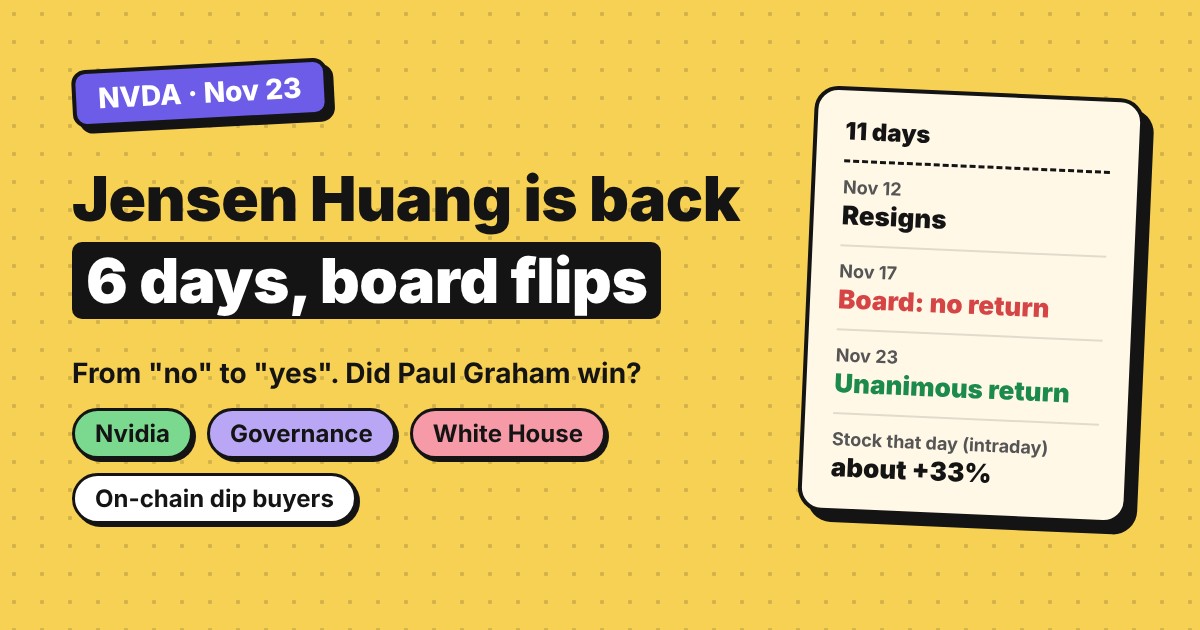
Update, November 23: the board reversed itself. On November 23, Nvidia’s board voted unanimously to reinstate Jensen Huang as president, CEO, and board director, effective immediately; Harvey Jones remains chair. The board said that after a series of discussions with Huang it was satisfied with his candor and ability to lead, and that it had “received input from senior levels of the United States government” and was confident his return poses no national security risk. The independent directors’ investigation will continue to its conclusion. Nvidia shares rose as much as about 34% intraday.
That means section 6’s judgment, that this wouldn’t reverse the way OpenAI did in 2023, was wrong. The text below is left as it was written on November 21; for the full recap, see Jensen Huang’s return.
The short version
- I understand PG’s frustration: a group of directors can use governance rules to remove the person who built Nvidia, yet they still haven’t answered the most practical question: where do they find another Jensen Huang?
- But “unanimous” doesn’t hold: Silicon Valley founders, VCs, and investors really are lopsided. Yet the most widely shared quote posts of PG’s tweet mostly push back on him.
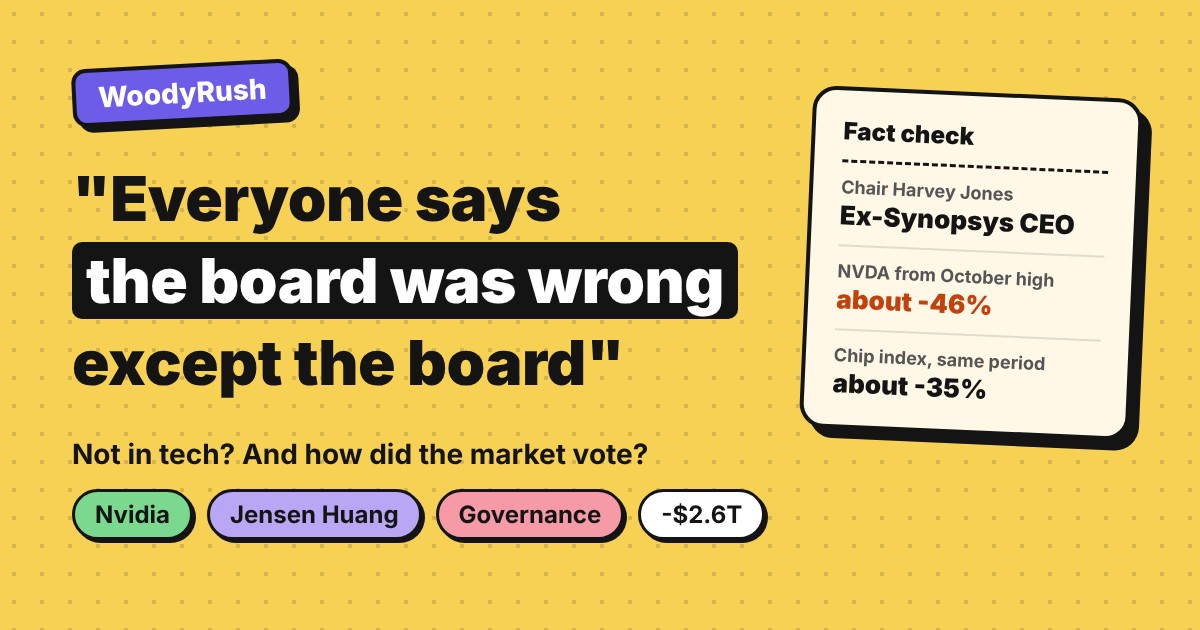
- “Not in tech” doesn’t hold either: chair Harvey Jones ran Synopsys and has been an Nvidia director since 1993. The board also includes partners from Sutter Hill and Sequoia, the firms that backed Nvidia early. Five months ago, shareholders re-elected him with about 90% of the vote.
- The market is voting with its feet, but not only over this: Nvidia is down about 46% from its October high, roughly $2.6 trillion in market value. But the slide began before Huang resigned, and the semiconductor index fell about 35% over the same period. The extra ten-odd points Nvidia lost are the upper limit of “Nvidia’s own problems,” and that bucket also includes the SEC probe and China revenue going to zero.
1. What happened: what’s official, and what isn’t
| Date | Event | Source |
|---|---|---|
| Early October | Nvidia stock peaks and starts falling | Multiple outlets |
| November 11 | The board accepts Huang’s resignation as CEO and director; CFO Colette Kress becomes interim CEO; Harvey Jones becomes board chair | Nvidia 8-K |
| From November 15 | The “Stand With Jensen” petition launches; Musk, Garry Tan, and others sign; signatures pass 180,000 | Multiple outlets |
| November 17 | Huang posts on X that he’d be willing to return if the board decides it serves shareholders, employees, the company, and America | Multiple outlets |
| November 17 | On the earnings call, Jones says Huang voluntarily resigned after disclosing “personal behavior inconsistent with the company’s code of conduct”; the board accepted unanimously and does not intend to reinstate him | Fortune and others |
| November 18 | Bill Ackman accuses the board of failing its fiduciary duty to shareholders | Benzinga |
| November 20 | Reuters reports the SEC is examining Nvidia’s accounting; Nvidia falls 14% in a day to close at $125.53, a seventh straight weekly loss | CNBC |
| November 21 | Paul Graham posts the tweet | X |
A few details worth noting:
- Officially, it was a voluntary resignation, not a firing. Huang forfeited about $108 million in stock awards and received no severance.
- The board ruled out his return before the investigation finished. It hired the law firm Wachtell Lipton to investigate, and there are no findings yet.
- On the earnings call, none of the eight analysts asked about the circumstances of the resignation.
2. Why PG’s frustration struck such a chord
This isn’t the first time PG has weighed in. On November 18 he posted something with even more engagement, roughly: it’s hard to imagine the board keeping a straight face while saying someone else is better suited to be CEO than Jensen Huang.
To me, this is the most absurd part of the whole affair: a group of directors can use corporate governance rules to remove the person who built Nvidia with his own hands and brought it to the center of the global tech industry. But when it’s time to actually find a replacement, where do they find another Jensen Huang?
That doesn’t mean Huang shouldn’t be held accountable for his own conduct. It means the board owes an answer to a very practical question too: are you protecting Nvidia, or protecting the decision you already made?
The strongest arguments from this side:
- Bill Ackman (about 74,000 likes): the problem is process. The board moved too fast, did too little due diligence, and didn’t adequately weigh the impact on customers, employees, and other stakeholders. Ruling out his return before the investigation concluded breached its duty of care. His proposal: if Huang is cleared on national security and other major shareholders back it, bring him back.
- Elon Musk (about 96,000 likes): many key partnerships rest on a handshake with Huang, and some of them will be lost without him. That’s a concrete point: much of Nvidia’s major customer relationships and supply chain arrangements are built on Huang’s personal credibility.
- Garry Tan (about 7,800 likes): “Bring Jensen back.”
A great tech company can take more than thirty years to get where it is. The board still hasn’t named a successor, or explained why it believes Nvidia will be better without Huang.
3. Is X really “unanimous”? It splits into two layers
I sampled about 80 replies and quote posts under the tweet. It’s been up for less than a day, so these proportions aren’t a full count, and the mood may still shift.
Layer one: Silicon Valley founders, VCs, and investors really are lopsided. The names above are the loudest, and the well-known petition signers are concentrated in this circle.
Layer two: the most widely shared quote posts mostly push back on PG. The highest-engagement quotes:
| Author | Engagement | View |
|---|---|---|
| Matthew Yglesias (political commentator) | about 775 likes | Mocks it as a serious misjudgment by the tech world |
| Dave Troy (researcher and writer) | about 378 likes | Calls it a cult of the leader in tech, detached from legal and national security reality |
| Matt Zeitlin (journalist) | about 212 likes | The board may have information that VCs and outside executives don’t |
The other side’s main arguments come down to four points:
- “Everyone thinks so” really means the YC and VC circle. The tech world isn’t the same as Silicon Valley venture capital.
- The board has investigation and compliance material that no outsider has seen.
- A board that can’t hold the company’s most valuable person to account has lost its reason to exist. As corporate governance expert Charles Elson put it, bringing him back would make the code of conduct meaningless.
- National security and export controls. For a chip company subject to export controls that has just stopped shipping H200s to China, this isn’t a purely private matter. Yale’s Jeffrey Sonnenfeld and former Medtronic CEO Bill George, among others, defended the board on these grounds in a Fortune commentary.
A few other positions are worth noting:
- Sam Altman said he feels “personal strong empathy” for Huang but doesn’t know enough to say whether he should return. He was pushed out by his own board in 2023, so the restraint is telling.
- The US government isn’t aligned either: Trump publicly backed Huang’s return, while Treasury Secretary Bessent said Nvidia should bring in an outside CEO.
- Interests at stake: the Fortune piece points out that several of the loudest voices for his return are major Nvidia customers or shareholders. They aren’t necessarily wrong, but they aren’t neutral.
In Chinese-language social media, discussion has mostly been reposting, with no high-engagement debate around this tweet.
4. “They are not in tech”: this part doesn’t hold up
This is the easiest line in PG’s tweet to check, and the weakest. Look at some key members of Nvidia’s board:
| Director | Background |
|---|---|
| Harvey Jones (chair) | Co-founded electronic design automation company Daisy Systems in 1981; became CEO of chip design software company Synopsys in 1987 and took it public in 1992; also co-founded Tensilica. Nvidia director since 1993, before Nvidia went public |
| Tench Coxe | Partner at venture firm Sutter Hill Ventures from 1989 to 2020, focused on IT investments; Sutter Hill was one of Nvidia’s earliest investors. Nvidia director since 1993 |
| Mark Stevens | Former partner at Sequoia Capital, also an early Nvidia investor |
| John Dabiri | Professor of aeronautics and mechanical engineering at Caltech |
| Stephen Neal (lead independent director) | Lawyer by background |
The board does include members with legal, financial, and other industry backgrounds, which is normal for a large public company. But the chair himself is a chip design industry veteran, and several senior directors are the venture partners who bet on Huang more than thirty years ago. Saying they’re “not in tech” doesn’t match the facts.
One more easily overlooked data point: at the June shareholder meeting this year, all ten directors were re-elected. Huang got 99% of the vote, Harvey Jones 90.7%, and lead independent director Neal 86.7%. Five months ago, shareholders still trusted this board.
So a more accurate framing: the split isn’t about “understanding tech.” It’s about who is accountable for what. Petition signers don’t bear the consequences of lawsuits, regulatory investigations, and national security reviews. The board does.
5. How the market voted: how much of $2.6 trillion belongs to this story
Look at the stock price alone and the market seems to side with PG. Put the timeline and peers side by side, and it gets much more complicated.
1. The slide started before the resignation
According to CNBC, Nvidia’s decline began before Huang resigned. The market had two worries at the time:
- Whether AI spending can last: after the US midterm elections, investors began questioning how long big tech’s AI capital spending could continue.
- Rising competition: Google’s in-house chips and AMD’s accelerators were seen as potential threats to Nvidia’s lead.
According to Reuters, by November 13, two days after the resignation announcement, Nvidia was already down about 30% from its high, with nearly $2 trillion in market value gone. By the November 20 close, the decline had widened to about 46%, roughly $2.6 trillion. Outlets put it anywhere from 44% to 47.5%.
2. Peers fell too
| From the October high (approx.) | Decline |
|---|---|
| Nvidia | 46% to 47.5% |
| Philadelphia Semiconductor Index | about 35% |
| AMD | about 33% |
| Nasdaq | about 18% |
| S&P 500 | about 12% |
Data from Axios and other outlets; methods and starting dates differ slightly, so read these as rough proportions.
The whole AI chip sector fell, and Nvidia only fell 10 to 15 points more than its peers. That extra slice is the upper limit of what can be attributed to “Nvidia’s own problems.”
3. Nvidia’s own problems aren’t just one thing
Even that extra slice can’t all be pinned on the board. Over the same period, Nvidia faced these other negatives:
- Huang’s departure, and the succession uncertainty that came with it.
- The SEC accounting probe: the stock’s decline deepened after Reuters reported it on November 20.
- China revenue going to zero: Nvidia stopped shipping approved H200s to China, and its Q4 guidance assumes zero China revenue. Last quarter that business was worth about $2.4 billion.
- The earnings “14-week” problem: Q3 revenue of $115.8 billion beat expectations, and the $130 billion Q4 guidance was also above consensus. But Q4 has 14 weeks, so weekly growth is only about 4% (TechTimes).
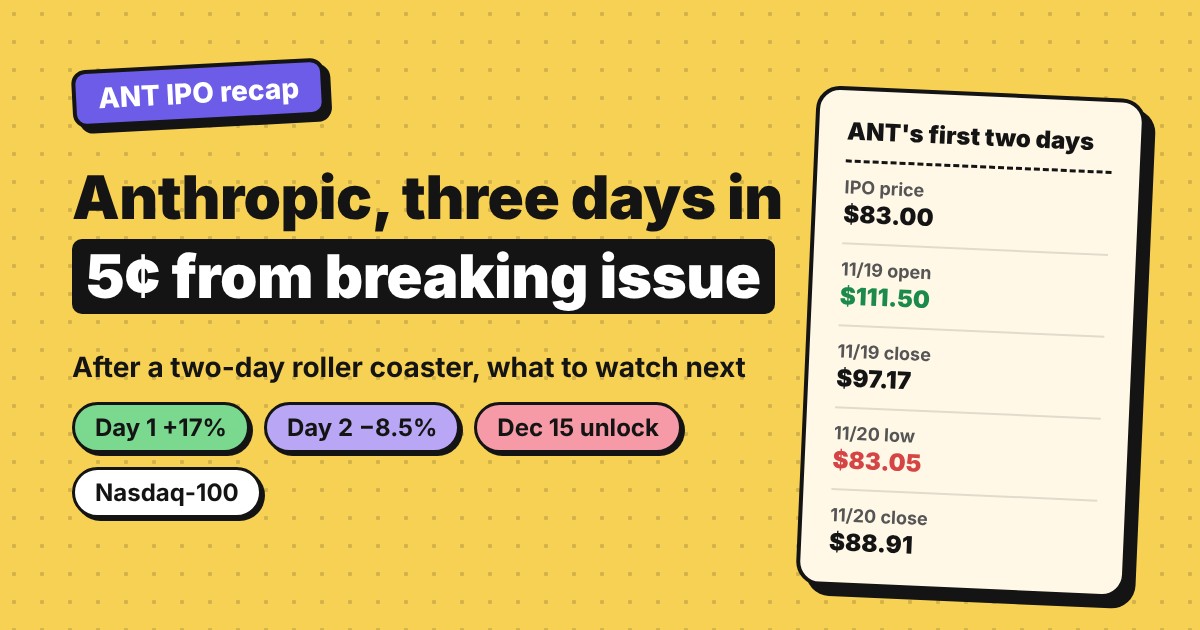
After earnings, the stock rose 3% after hours, then turned lower the next day. Anthropic’s Nasdaq debut on November 19 didn’t change sentiment in the AI sector either. Nvidia has reportedly slipped behind Alphabet in market value.
4. A contrary signal from crypto markets
Interestingly, crypto traders went the other way. According to data cited by Cointelegraph, the total market cap of on-chain Nvidia tokens rose 159% from November 8 to 17, while the stock fell about 17% over the same period. That means a lot of traders were buying tokens on the way down. Nvidia perpetual futures on Hyperliquid hit about $2 billion in daily volume at one point. As I found in another post, the week Bitget’s rToken set its weekly volume record was this same week.
My take: the market did vote against this, but with fewer votes than it looks. Most of Nvidia’s $2.6 trillion loss is the broader AI sector pulling back. The Nvidia-specific part mixes three things at once: the CEO’s departure, the SEC probe, and China revenue going to zero. Charging all of it to the board isn’t fair. Saying the market doesn’t care isn’t right either.
6. Could this reverse like OpenAI in 2023?
Many people will think of OpenAI in November 2023: the board abruptly fired Sam Altman, employees threatened to quit en masse, Microsoft stepped in with a landing spot, and five days later Altman was back and the board was overhauled.
| OpenAI 2023 | Nvidia 2026 | |
|---|---|---|
| How the CEO left | Fired by the board | Resigned; the board accepted |
| The board’s reason | ”Not consistently candid,” vague | Publicly cited personal conduct violating the code of conduct |
| Board split? | Split quickly; a director publicly regretted the vote | Chair publicly says the decision was unanimous and no reinstatement is planned |
| Outside leverage | Microsoft offered to take the whole team | No comparable landing spot |
| Type of company | Startup controlled by a nonprofit | Heavily regulated public company, also facing an SEC probe |
Altman came back because the board’s reasoning was shown not to hold up, and because Microsoft offered an alternative. Neither condition exists this time. The more realistic path is the one Ackman describes: wait for the investigation, and if Huang is cleared on national security, have major shareholders apply pressure together.
Update, November 23: this judgment was wrong. The reversal took two days, and it didn’t follow the path I described: the investigation isn’t finished. What made the difference was input from senior levels of the US government, and the board’s own reassessment.
Final thoughts
The first half of PG’s tweet captured what a lot of people genuinely feel. The second half traded accuracy for a good line. Nvidia’s board isn’t a group of outsiders who don’t understand tech. They’re the very people who bet on Huang more than thirty years ago.
But that doesn’t make the board right. It ruled out his return before the investigation concluded, hasn’t named a successor, and hasn’t explained why Nvidia will be better without Huang. It still hasn’t responded to the process questions Ackman raised.
The question that increasingly deserves an answer probably isn’t whether Huang can go back. It’s what makes this board think Nvidia will be better without him.
Update, November 23: two days later, the board answered that question with action: it brought Huang back.
Three things to watch next: Wachtell Lipton’s findings, the board’s choice of CEO, and whether Nvidia can close the performance gap with the semiconductor sector. Those will answer who was right better than any tweet.
Sources: Paul Graham’s original post, Nvidia 8-K, Nvidia 2026 proxy statement, Nvidia FY2026 annual report, TipRanks: 2026 annual meeting results, Nvidia: Harvey Jones bio, Fortune: Harvey Jones on the earnings call, Fortune commentary: what the Bring Back Jensen camp gets wrong, Benzinga: Bill Ackman criticizes the board, Decrypt: tech, AI and crypto reactions, Semafor: tech leaders pick sides, Axios: Trump backs a return, Axios: AI stock selloff, CNBC: seven-week losing streak, CNBC: Q3 earnings, TechTimes: the 14-week guidance, Reuters: SEC examines Nvidia’s accounting, Cointelegraph: on-chain Nvidia market cap up 159%, Wikipedia: removal of Sam Altman from OpenAI. X engagement figures are a sampled snapshot from November 21. Research current as of November 21, 2026.