Two days ago, in my post on Paul Graham and Nvidia’s board, I made a call: this wouldn’t reverse the way OpenAI did in 2023. I laid out the reasons carefully: the chair had publicly ruled out reinstatement, there was no outside lever like Microsoft, and the investigation hadn’t concluded.
Today, November 23, Nvidia’s board voted unanimously to reinstate Jensen Huang as president, CEO, and board director, effective immediately.
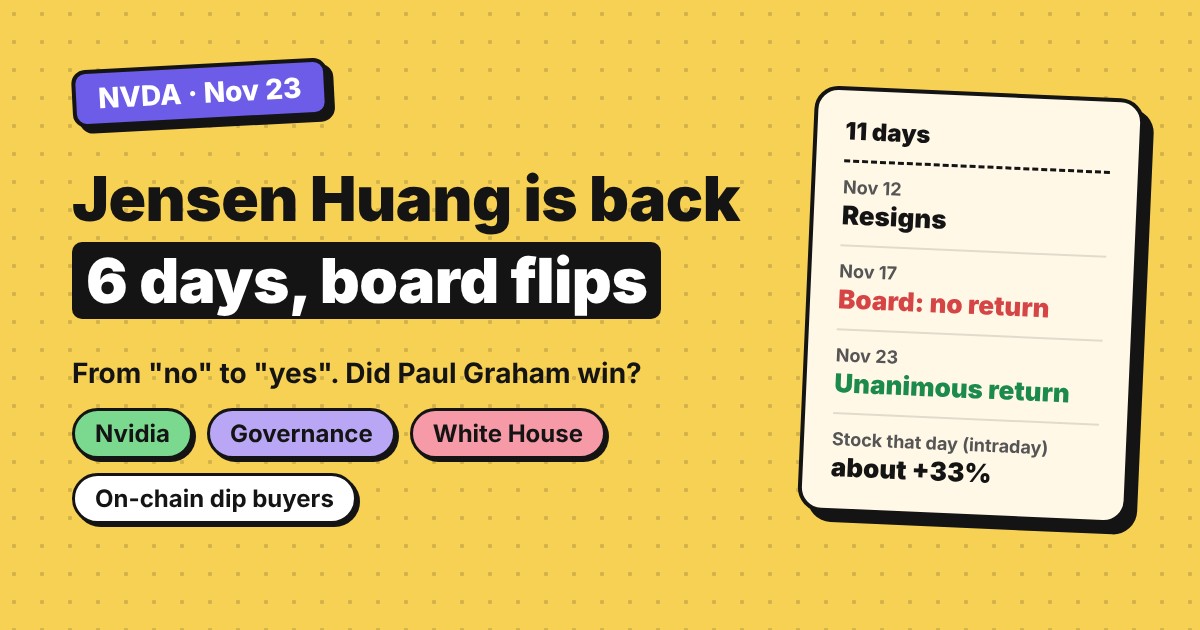
I was wrong, and it didn’t take long. From resignation to reinstatement: 11 days. From the chair saying on the earnings call that the board “does not intend to reinstate” him to a unanimous vote bringing him back: six days.
This post tries to pin down three things: what the board actually said when it reversed itself, what changed its mind, and how the market and on-chain traders reacted.
A quick reminder: this isn’t investment advice. The claims about Huang’s private life and an intelligence operative come only from media reports; they’re not in any official filing, the investigation is ongoing, and I won’t go into them. Stock figures are intraday on November 23; check the exchange for the close.
The bottom line first
- It reversed, but not by the tech world’s script. The tech world campaigned for a week and the board didn’t budge. What made the difference, in the board’s words, was “input from senior levels of the United States government.” Trump told CNBC: “I made the deal.”
- The board changed its story. Six days ago, it said Huang resigned after disclosing “personal behavior inconsistent with the company’s code of conduct.” Today, it says Huang “has been the target of a foreign intelligence effort.”
- The investigation isn’t finished. The board ruled out reinstatement before the investigation concluded, then decided to reinstate him before it concluded. The independent directors’ committee will continue its work.
- The market recovered nearly $1 trillion in a day. Nvidia was up as much as about 33% intraday, but it’s still roughly 30% below its 52-week high.
- On-chain dip buyers made money. In the week Huang resigned, a lot of traders bought Nvidia tokens on-chain; today, Ondo’s Nvidia token rose about 30%.
1. An 11-day timeline
| Date | Event |
|---|---|
| November 12 | Nvidia announces the board has accepted Huang’s resignation as president, CEO, and director; CFO Colette Kress becomes interim CEO; Harvey Jones becomes chair |
| From November 15 | The “Stand With Jensen” petition launches; Musk, Garry Tan, and others sign |
| November 16 | Trump publicly backs Huang’s return; Treasury Secretary Bessent calls for an outside CEO |
| November 17 | Huang posts on X that he’s willing to return; on that day’s earnings call, Jones says the board “does not intend to reinstate” him |
| November 18 | Bill Ackman accuses the board of failing its fiduciary duty to shareholders |
| November 20 | Reuters reports the SEC is examining Nvidia’s accounting; Nvidia falls 14% to close at $125.53 |
| November 21 | Paul Graham tweets: “Everyone in tech thinks the board made a huge mistake. Except the board.” |
| November 22 | Bessent softens his earlier call for a new CEO on CBS |
| In between | According to Semafor, Trump dialed into one of Nvidia’s board meetings to argue for Huang’s reinstatement |
| November 23 | The board unanimously reinstates Huang as president, CEO, and director; Kress returns to CFO; Jones remains chair; the stock rises as much as about 33% intraday |
(Sources: Nvidia announcement, Nvidia 8-K, CNN, Axios, CNBC, The Hill)
Some reports say Huang was also reinstated as chair. That’s wrong: the official announcement states that Harvey Jones remains chair.
2. What changed in the board’s story
Put the board’s statements from six days ago and today side by side, and the shift is obvious:
| November 17 (earnings call) | November 23 (reinstatement announcement) | |
|---|---|---|
| How it described Huang’s departure | Voluntarily resigned after disclosing “personal behavior inconsistent with the company’s code of conduct, standards, and cultural norms” | Huang “has been the target of a foreign intelligence effort” |
| Position on reinstatement | ”Does not intend to reinstate Jensen as CEO” | Unanimous reinstatement; “the right person to lead NVIDIA” |
| Reasoning | Not given | After a series of discussions and meetings with Huang, satisfied with his candor and ability to lead |
| National security | No statement | ”Received input from senior levels of the United States government” and confident the reinstatement poses no national security risk |
| Investigation | Ongoing | A committee of independent directors will continue to its conclusion |
The first row matters most. Six days ago, the problem was framed as Huang’s own conduct; today, he’s framed as the target of a foreign intelligence effort. The two descriptions aren’t necessarily contradictory, but their emphasis is completely different: one says “he did something wrong,” the other says “he was targeted.”
And in those six days, the investigation didn’t conclude.
3. What actually changed the board’s mind
The official reasons are two: after several conversations with Huang, the board was satisfied with his candor; and it received input from senior levels of the US government.
How much the second one weighed is clear from what the parties have said:
- Trump told CNBC “I made the deal,” and said there’s no reason to believe Huang is a national security risk.
- The White House communications director said Trump was “totally involved.”
- According to Semafor, Trump dialed into one of Nvidia’s board meetings to argue for Huang’s reinstatement.
There’s pushback too: Senator Elizabeth Warren issued a statement, and Representative Greg Casar said Huang must testify under oath.
To me there’s one question that can’t be avoided: the board ruled out reinstatement before the investigation concluded, and then decided to reinstate him before it concluded. A week ago, Ackman criticized the board for ruling out his return “before the facts were clear.” Today that criticism cuts the other way: deciding to bring him back before the facts are clear is also a decision made ahead of the findings. The only difference is that this time, the decision went the way the market and the tech world wanted.
What this means for corporate governance may take a long time to become clear. A public company’s board reversing its CEO decision after input from senior government officials isn’t common among large US companies.
4. Did Paul Graham win?
On the outcome, yes. The tech world wanted Huang back, and he’s back.
Look at how it happened, though, and it’s less clear-cut.
The tech world’s arguments didn’t persuade the board. When the board said “no” on November 17, the petition and statements from Musk and others were already everywhere; after that, Ackman’s criticism and PG’s tweets piled on, and the board showed no sign of budging. What actually turned things around was intervention at the government level.
“They are not in tech” didn’t become any truer today. It’s the same board, and the chair is still Harvey Jones, who joined Nvidia’s board in 1993. The board members didn’t change; what changed was the information they had and the pressure they faced.
So PG won on the outcome, but not on the argument. As for my own call in the last post, that this wouldn’t reverse like OpenAI, it was wrong. I thought a reversal needed two things: the board’s reasoning falling apart, plus an outside lever like Microsoft. Looking back today, the second condition did show up; the lever just wasn’t a company. It was the White House.
5. The market: nearly $1 trillion back in a day
| November 23, intraday (approx.) | Gain |
|---|---|
| Nvidia | about +33%, from $125.53 to about $167 |
| Intel | about +13% |
| AMD | about +8% |
| S&P 500 | up as much as about 5% |
| Nasdaq | up as much as about 6% to 7% |
Data from Yahoo Finance, Investing.com, and others; snapshots were taken at different times, so figures vary.
A few observations:
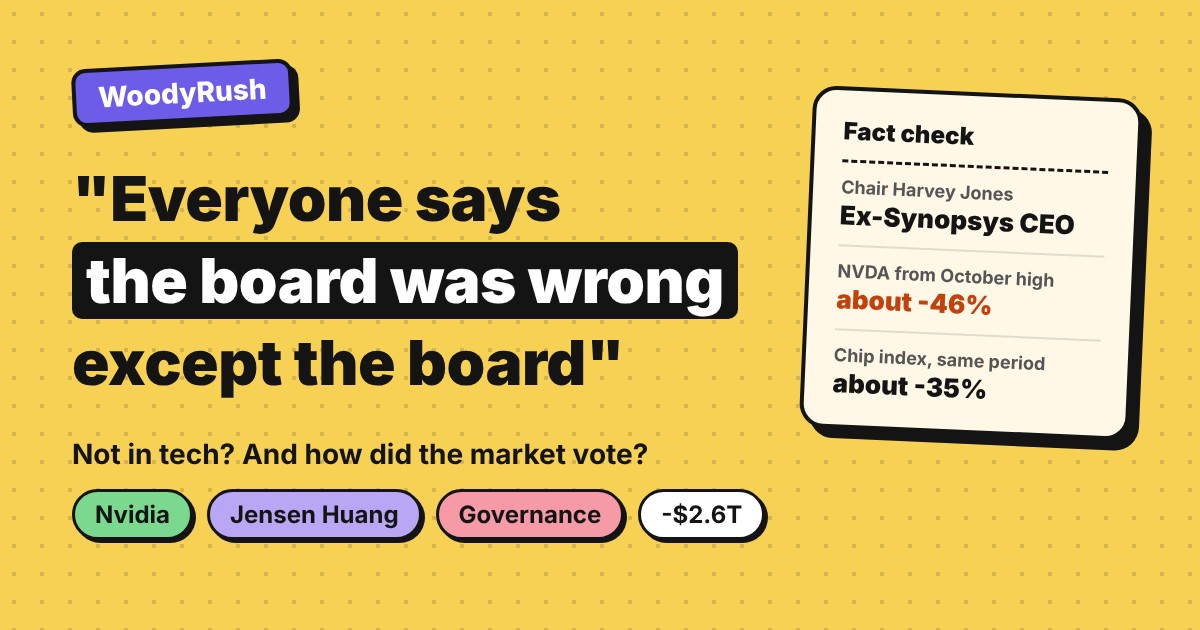
1. Nvidia recovered nearly $1 trillion in market value, but it’s still far from its high. At about $167, Nvidia is still roughly 30% below its 52-week high of $243.37 (my math). It had fallen about 46% from its October high, and today it recovered only part of that.
2. This time, Nvidia clearly beat its peers. In my last post I worked out that from the October high to November 20, Nvidia fell 10 to 15 points more than the semiconductor index; that was the upper limit for “Nvidia’s own problems.” Today, Nvidia gained more than 20 points more than AMD. Of course, today’s sector-wide rebound was itself driven by the Nvidia news, so you can’t simply subtract one from the other. But at the very least, the market puts a high price on Huang himself.
3. Risk appetite came back across the board. Bitcoin dipped to about $55,000 over the weekend and rebounded above $60,000 on Monday with the Nvidia news; reports put it between $61,000 and $64,000. Crypto and AI stocks are looking more and more like the same kind of risk asset.
4. Some reports say the rally quickly ran into profit-taking. Check the close for where it actually ended.
6. On-chain: the dip buyers got paid
There’s a complete storyline here on-chain.
- In the week he resigned, people bought the dip on-chain. According to data cited by Cointelegraph, the total market value of on-chain Nvidia tokens rose 159% from November 8 to 17, and supply grew about 121%, while the stock fell about 17% over the same period.
- On the day he came back, they got paid. According to Ondo data cited by Cryptotimes, Ondo’s Nvidia token NVDAon rose 29.6% in the 24 hours to 15:53 UTC on November 23, to $169.02, after a low of $130.49. Nvidia tokens on different platforms rose by different amounts, a reminder that on-chain prices can drift from the stock.
But on OKXICE, the regulated US on-chain venue, that opportunity didn’t exist: Nvidia has objected to third-party tokenization, and OKXICE launched with just six crypto-company stocks on day one. I wrote about that contrast in the OKXICE post.
7. Three things that aren’t over
Huang is back, but this is far from finished.
- The independent directors’ investigation. The board says it will proceed to its conclusion, and Huang says he fully supports it. If its findings don’t match today’s story, the board will be in an awkward position.
- The SEC accounting probe. Reuters reported on November 20 that the SEC is examining Nvidia’s accounting. That’s separate from Huang’s personal matter, and there’s no sign it has ended.
- China and export controls. Nvidia has stopped shipping approved H200s to China, and its Q4 guidance assumes zero China revenue. Huang’s return won’t change that on its own.
On top of that, members of Congress are already demanding that Huang testify under oath, so the political side of this will keep going.
Final thoughts
When I wrote the PG post two days ago, I ended on a question: what makes this board think Nvidia will be better without Huang?
Today the board gave its answer: it no longer thinks so.
What bothers me more is how it got there. Not because the investigation concluded, and not because the tech world’s arguments persuaded it, but by reversing itself in six days after senior US government officials weighed in.
For Nvidia’s shareholders, this is probably good news; the stock price says as much. For the idea of “corporate governance,” it may leave more questions than answers.
As for me, I got this one wrong, and I’ll own it: the outside lever a reversal needs doesn’t have to be a company. It can be a government.
FAQ
Has Jensen Huang been reinstated?
Yes. On November 23, Nvidia’s board voted unanimously to reinstate Huang as president, CEO, and board director, effective immediately, 11 days after he resigned on November 12.
Is Jensen Huang Nvidia’s chair?
No. The official announcement states that Harvey Jones remains chair of the board. Jones was appointed Nvidia’s first-ever board chair when Huang resigned.
Why did Nvidia’s board change its mind?
Officially, for two reasons: after a series of discussions with Huang, the board was satisfied with his candor and ability to lead; and it received input from senior levels of the US government and is confident the reinstatement poses no national security risk. Trump told CNBC that “I made the deal.”
Is the investigation into Huang over?
No. The board says a committee of independent directors will continue its investigation to its conclusion, and Huang says he fully supports it. Separately, the SEC’s examination of Nvidia’s accounting is a different matter, and there’s no news that it has ended.
How much did Nvidia stock rise after Huang was reinstated?
It was up as much as about 33% intraday on November 23, from the previous close of $125.53 to about $167. Reported intraday figures range from 26% to 34%; check exchange data for the close.
Sources: Nvidia: board reinstates Jensen Huang, Nvidia 8-K (November 23), Nvidia 8-K (November 12), CNN, CNN live updates, CNBC: Trump says “I made the deal”, Axios, MS NOW: Trump says he intervened, TechCrunch, The Hill, Yahoo Finance live updates, Yahoo Finance: Nvidia up 28%, Intel up 13%, Investing.com, Fortune: Harvey Jones on the earnings call, Cointelegraph: on-chain Nvidia market cap up 159%, Cryptotimes: NVDAon up 29.6%, CoinDesk live updates: bitcoin rebounds. Research current as of November 23, 2026.