On Monday, November 23, OKXICE, the joint venture of OKX and NYSE parent ICE, goes live in the US: 24/7 trading, on-chain, with more than 70 assets in the first batch.
Almost every headline I’ve seen this week calls it “the first legal tokenized stock exchange in the US.” I believed it at first too. Then I dug into the SEC paperwork and found that’s not quite right. Someone else got there first, and their first trade went through on November 4.
But the further I read, the more something else bothered me: Apple, Nvidia, the stocks people actually want, can’t be bought here at all. Americans can finally trade stocks on-chain legally, and they get far less to choose from than offshore platforms offer.
A quick reminder: this isn’t investment advice. OKXICE hasn’t launched yet, and everything I have comes from public reporting and secondhand accounts of SEC filings, as of November 22. What’s actually tradable, the fees, and how much volume it does, I’ll cover in a follow-up after its first week.
Update, November 23: only six stocks on day one. According to OKXICE’s November 20 launch notice, only six stocks are tradable on day one: Coinbase, Securitize, Strategy, BitGo, Robinhood, and Circle, all paired with USDC, with tokenization handled by Securitize Markets. The 59 Direxion ETFs and Strategy’s preferred stock from the original plan aren’t in that notice, and it hasn’t been confirmed whether they’ll trade on day one (TechTimes, Cryptonews). One other source says trading in each stock is capped at 0.25% of the previous month’s average daily volume, with no borrowing allowed; I haven’t verified that against the official notice. Where the text below says “70-plus assets,” it refers to the original plan.
The bottom line first
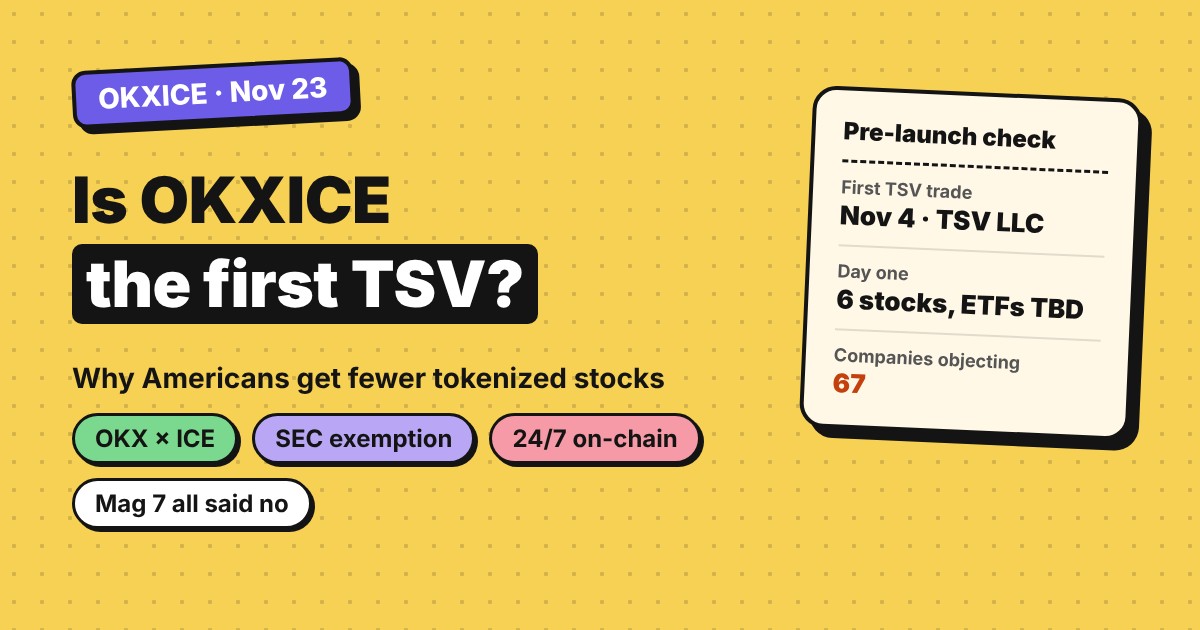
- It isn’t the first TSV. The SEC issued its “innovation exemption” on September 17. On September 23, an entity called TSV LLC became the first to file a notice with the SEC; on November 4, it completed the first tokenized US stock trade under the exemption, on the Canton Network. OKXICE didn’t file until October.
- It may be the first “big” TSV: run by a major exchange group, aimed at retail, traded through a mainstream app, listing stocks tokenized by third parties, and launching with more than 70 assets at once.
- There isn’t much to buy: the original plan was 70-plus assets, 59 of them Direxion ETFs; but the November 20 launch notice lists only six stocks, all crypto-related companies like Coinbase, Circle, Robinhood, and Strategy, and it’s unconfirmed whether the ETFs trade on day one. Apple, Nvidia, and the rest of the Magnificent Seven all said no.
- Why the US gets less: the rules let listed companies say no to third-party tokenization, and 67 of them have. Offshore products like Ondo and Binance bStocks can offer Nvidia because they don’t operate under these rules, and the price is that holders get a note or certificate, not shareholder rights.
- For readers outside the US: it’s currently open only to “eligible US users,” and nothing suggests non-US users can access it.
1. What a TSV is
TSV stands for Tokenized Securities Venue. It’s a new category the SEC created in a temporary order issued on September 17, 2026, commonly called the “Innovation Exemption.”
According to law firm analyses (Simpson Thacher, Skadden, Davis Polk), the core of the exemption is:
| Point | Details |
|---|---|
| What trades | Tokenized NMS stocks, meaning stocks listed on US national exchanges |
| How it trades | Through AMM (automated market maker) liquidity pools, with vetted participants |
| What’s exempted | No need to register as a national securities exchange or operate as an ATS (alternative trading system); some liquidity providers don’t need to register as dealers |
| Duration | Five years, through September 17, 2031 |
| Token requirements | Must carry the same rights as the underlying stock; third-party tokens offering “synthetic exposure” are excluded |
| Issuer veto | Before offering a third-party tokenized version of a company’s stock, the venue must give that company at least 30 days’ written notice, and the company can object; objections apply venue by venue |
| SEC approval? | The SEC doesn’t approve or designate venues individually; meet the conditions and file a notice |
Two points are worth highlighting:
- “SEC-approved exchange” is wrong. OKXICE itself states that it is not a registered exchange or broker-dealer, and has not been approved by the SEC; it operates under a temporary exemption.
- The exemption settles the status of the venue, not the token. The order doesn’t resolve the legal status of the tokens themselves.
2. Is OKXICE the first TSV? No
The timeline makes it clear:
| Date | Event |
|---|---|
| September 17 | SEC issues the innovation exemption |
| September 23 | TSV LLC becomes the first to file a venue notice with the SEC |
| Early October | OKXICE files its notice (reports put the date between October 4 and 11) |
| October 8 | Securitize Stocks launches on Solana, but it doesn’t use the innovation exemption; it relies on its existing broker-dealer and ATS registrations |
| October 29 | Nasdaq-listed Canton Strategic Holdings (CNTN) discloses its deal with TSV LLC to tokenize its own shares |
| November 4 | TSV LLC completes the first tokenized US stock trade under the innovation exemption, in CNTN, on the Canton Network through the Tradecraft protocol (press release) |
| November 5 | OKXICE’s regulatory filing shows 67 companies have objected |
| November 20 | Fairmint announces plans to run a TSV on Canton; trading hasn’t started (CoinDesk) |
| November 23 | OKXICE TSV launches |
Separately, Formation Securities reportedly plans to launch a TSV on Solana in early 2027, and Perpetuals.com has also filed a notice with the SEC.
So the first to file and the first to trade were both TSV LLC, not OKXICE.
But there’s a key difference between them: TSV LLC’s first trade was a listed company tokenizing its own stock, which needs nobody’s permission. Most of what OKXICE lists is tokenized by a third party, which has to go through the “notify the company, wait 30 days, see if it objects” process. That’s why 67 objections became news.
A more accurate description: OKXICE is likely the first TSV run by a major exchange group, aimed at retail, and listing third-party tokenized stocks at meaningful scale. But the title of “first TSV” belongs to TSV LLC.
3. What you can buy: 70-plus planned, six stocks on day one
OKXICE reportedly plans to list more than 70 assets in its first batch (CoinDesk, Cryptonews):
| Category | Assets |
|---|---|
| ETFs | 59 Direxion ETFs |
| Stocks | Coinbase (COIN), Circle (CRCL), Robinhood (HOOD), Strategy (MSTR), BitGo, Securitize, Better.com |
A few observations:
- ETFs make up over 80%. By one count, ETFs are about 89% of the named list and about 84% of all 70-plus assets. Direxion is known for leveraged and inverse ETFs, but I couldn’t find the full list of which 59 these are.
- The stocks are almost all crypto-related companies: an exchange, a stablecoin issuer, a broker, a bitcoin treasury company, custody and tokenization providers. These companies are already on the side of tokenization, so it’s no surprise they’re willing to put their stock on-chain.
- Not everything may be live on day one. Some reports say the full list won’t open all at once.
In other words, this isn’t a list of whatever OKXICE wanted to offer. It’s what’s left after listed companies didn’t object and ETF issuers agreed to cooperate.
4. Why 67 companies said no
According to OKXICE’s November 5 filing, at least 67 companies objected, including Apple, Nvidia, Microsoft, Amazon, Meta, Tesla, and Alphabet, the entire Magnificent Seven, plus JPMorgan Chase, CoreWeave, Palantir, and SpaceX (Bitcoin Magazine, CFO Brew). By CoinDesk’s count, 56 of the 62 companies OKXICE originally targeted objected, about 90%.
Nasdaq’s chief legal officer has also reportedly said Nasdaq plans to opt its own stock out of TSVs.
Most of these companies haven’t explained why. My guesses (not their official reasons):
- Control over the shareholder base. Who holds the tokens, on which chain, and how they vote may not be visible to the company.
- Price fragmentation. The same stock has one price on the exchange and another in an on-chain AMM pool, and on weekends only the on-chain one trades. When they diverge, the company may face investor confusion and complaints.
- Legal and reputational risk. If something goes wrong on-chain, like a contract bug or an abnormal price, investors’ first thought is often the company itself, not the venue.
- No obvious upside. These companies don’t lack liquidity or investors. For them, tokenization offers little benefit and real risk.
One more point: whether a listed company can bar its stock from trading on a particular venue is itself contested. Whether this veto mechanism gets challenged is worth watching.
5. How trading works
What’s known:
- Timing: reportedly opens at 9 a.m. on November 23 (check the official announcement for the time zone), then trades 24/7.
- Chain: X Layer, OKX’s own layer 2 network.
- Matching: AMM liquidity pools, reportedly built on Uniswap v4, with vetted participants.
- Access: the OKX app.
- Users: eligible US users.
What’s not known:
- Fees: no public figures found.
- Pool depth, who provides liquidity, whether there are incentives: no public figures.
- Whether non-US users can access it: nothing suggests they can.
One thing worth watching is price. Prices in an AMM pool are kept in line with the stock by arbitrageurs. When the US market is open, arbitrageurs can hedge in the stock itself; on weekends and overnight, the stock doesn’t trade, so the pool price has no direct anchor. Offshore tokenized stocks face the same problem on weekends; the difference is that OKXICE’s price is set by an on-chain AMM, so any divergence will be more public and easier to observe.
6. How people outside the US buy US stocks on-chain today
This is the most useful part for readers outside the US. OKXICE is only open to US users, so what are the alternatives? I picked the three most representative and compared them with OKXICE: Ondo’s tokenized stocks, Binance’s bStocks, and buying real stocks directly on Binance.
First, who each one is and what framework it operates under:
- OKXICE TSV: the OKX and ICE joint venture, operating under the SEC innovation exemption, open only to eligible US users.
- Ondo Stocks (formerly Ondo Global Markets): issued by Ondo Global Markets (BVI), approved for offering in 30 EU countries, for qualified investors outside the US, KYC required.
- Binance bStocks: issued by Binance affiliate BTech Holdings, a special purpose vehicle in Abu Dhabi’s ADGM, with prospectuses approved by the ADGM regulator; not available to US persons.
- Binance US stocks: offered through Binance’s ADGM broker-dealer Nest Trading, with execution, clearing, and custody by US broker Alpaca, for eligible users outside the US.
What you hold:
| OKXICE | Ondo | bStocks | Binance stocks | |
|---|---|---|---|---|
| What you hold | Token with the same rights as the stock | Structured note | Certificate | Binance says you hold shares directly |
| Shareholder? | Should be, per the rules | No | No | Binance says yes |
| Voting rights | Should match the stock | No | No | Not clearly stated |
| Dividends | TBA | Reinvested | Via an on-chain multiplier, among other methods | Yes |
| Issuer veto | Yes | N/A | N/A | N/A |
How you trade:
| OKXICE | Ondo | bStocks | Binance stocks | |
|---|---|---|---|---|
| Nvidia, Apple available | No | Yes | Yes | Yes |
| Number of assets | 6 on day one (70+ planned) | 470+ | Not counted | 7,000+ |
| 24/7 trading | Yes | Yes | Yes | Per platform rules |
| On-chain | X Layer | Solana, Ethereum, others | BNB Chain | No |
Sources are listed at the end. Ondo’s 470-plus figure comes from a single source; the four differ in how much detail they give on dividends and voting rights, so check each one’s terms before trading.
Put the four side by side and a few patterns are clear:
1. The more you can buy, the weaker the holder’s rights tend to be. OKXICE’s rules require tokens to carry the same rights as the stock, so big companies said no and there’s little to buy. Ondo and bStocks offer Nvidia and Apple, but holders get a note or certificate, not shareholder status, and no voting rights. That’s the trade-off between the two routes: full rights with few assets, or many assets with diluted rights.
2. Binance does both real stocks and on-chain tokens, and they convert into each other. Binance’s stock service lets users hold shares directly, in custody at Alpaca; bStocks are on-chain certificates. The two convert 1:1, handled by Nest Trading. So if you want full shareholder rights, hold the real stock; if you want 24/7 trading and on-chain access, convert to bStocks. This is the offshore arrangement closest to OKXICE’s “same rights” model, but it means trusting both Binance’s affiliates and its custody chain.
3. On-chain size is still tiny. According to DefiLlama and similar data providers, Ondo’s Nvidia token NVDAon has about $45 million on-chain, and Binance’s NVDAB about $9.6 million. The providers disagree with each other, so read these as orders of magnitude. Nvidia’s actual market value, by comparison, is measured in trillions.
4. The issuer veto only works inside the US TSV framework. Apple and Nvidia can refuse OKXICE, but they can’t stop Ondo or bStocks, because those don’t operate under the SEC innovation exemption. The same company’s stock can’t be bought on a regulated US on-chain venue, yet its token can be bought on offshore platforms.
So OKXICE’s launch doesn’t give anyone outside the US a new way to buy US stocks. Its significance is more that the US now has, for the first time, an on-chain venue run by a major exchange group, aimed at retail, with tokens carrying the same rights as the stock: a reference point for all those offshore “notes” and “certificates.” Next time a platform says “on-chain US stocks,” ask one question first: is what I hold a stock, a note, or a certificate?
7. Market backdrop: crypto is falling, tokenized stocks are rising
OKXICE’s timing is unusual.
- Bitcoin has fallen about 23% since the start of November, briefly dropping to about $55,000 on November 21, its lowest since September 2024.
- Over the same stretch, according to The Block, the total value of on-chain tokenized stocks passed $4 billion on November 11 and didn’t follow crypto prices down. For comparison, RedStone put it at about $3.17 billion at the end of September (RedStone).
- In the week of Nvidia’s crisis, the market value of on-chain Nvidia tokens rose 159%, a sign that traders were buying the dip. I wrote about this in another post.
- SEC Chair Atkins has also been talking publicly about tokenization and 24/7 trading.
These figures come from different sources with different methods, so they can’t be added up or compared directly, but they point the same way: some crypto money is moving into on-chain US stocks. OKXICE is arriving at that moment.
8. What to watch after launch
- First-week volume. With only six stocks on day one, how much it trades is the most direct test of retail demand.
- On-chain price divergence from the stock. Especially on weekends and overnight: how large, and how fast it converges.
- When the ETFs go live. 70-plus assets were planned, the day-one notice lists only six stocks, and when the 59 ETFs can trade depends on later notices.
- Whether any big company “changes its mind.” If one major company withdraws its objection, the list means something completely different.
- Progress at other TSVs. Fairmint, Formation and others are lining up, and competition will shape fees and liquidity.
- Whether the veto gets challenged. That will decide how far the TSV route can go.
I’ll do a data follow-up one week after launch.
Final thoughts
OKXICE isn’t the first TSV, but it carries more weight than the first one did: the NYSE’s parent company plus a top crypto exchange, together turning on-chain stock trading into a retail product under the SEC’s framework for the first time.
But how it looks at launch exposes exactly where this route gets stuck: the rules give listed companies a veto, and the most valuable companies all chose to sit it out. Americans can finally trade stocks on-chain, legally, around the clock, but on day one, all they can trade is shares of six crypto-related companies.
For users outside the US, nothing changes in the short term. Nvidia and Apple tokens are still only available through offshore products, and their rights structure is completely different from OKXICE’s tokens. Seeing that clearly matters more than knowing who was first.
FAQ
Is OKXICE the first TSV?
No. TSV LLC was the first to file a notice with the SEC, on September 23, and completed the first tokenized US stock trade under the innovation exemption on November 4. OKXICE may be the first TSV run by a major exchange group, aimed at retail, and listing third-party tokenized stocks at meaningful scale.
Is a TSV an SEC-approved exchange?
No. TSVs operate under a temporary SEC exemption; they don’t have to register as exchanges, and the SEC doesn’t approve venues individually. OKXICE itself states that it is not a registered exchange or broker-dealer and has not been approved by the SEC.
Can people outside the US use OKXICE?
It’s currently open only to eligible US users, and nothing suggests users outside the US can access it.
Can you buy Nvidia or Apple on OKXICE?
No. Apple, Nvidia, and the rest of the Magnificent Seven have all objected. The day-one notice lists only six stocks: Coinbase, Circle, Robinhood, Strategy, BitGo, and Securitize. Whether the 59 Direxion ETFs from the original plan trade on day one hasn’t been confirmed.
What are the alternatives to OKXICE for people outside the US?
The common ones are: Ondo’s tokenized stocks (structured notes, not shareholder status, no voting rights), Binance bStocks (certificates that convert 1:1 with real shares), and buying real stocks on Binance (Binance says users hold the shares directly, in custody at Alpaca, but not on-chain). The first two trade 24/7 and offer Nvidia, but neither is inside the SEC’s TSV framework, and US persons can’t use them.
How do OKXICE tokens differ from Ondo and bStocks?
TSV rules require tokens to carry the same rights as the underlying stock, and listed companies can object. Ondo and bStocks aren’t in that framework: holders get a note or certificate with no voting rights, but listed companies can’t block them, so they offer stocks like Nvidia and Apple.
Sources: The Block: OKXICE sets Nov. 23 launch, OKX: OKXICE TSV launch, CoinDesk: OKXICE’s first listings, Cryptonews: 70 assets and 59 Direxion ETFs, crypto.news: 67 companies object, Bitcoin Magazine: the objectors, CFO Brew: Apple and Nvidia aren’t excited, Decrypt: OKX and ICE’s 24/7 plan, CoinDesk: SEC rolls out the innovation exemption, Simpson Thacher analysis, Skadden analysis, Davis Polk analysis, Harvard Law School Forum on Corporate Governance, Tradecraft press release: first trade, Yahoo Finance: Canton Strategic Holdings tokenizes its own shares, CoinDesk: Fairmint plans a TSV, The Block: tokenized stocks shrug off the crypto selloff, RedStone tokenized stocks report, MetaMask: What is Ondo Stocks, Genfinity: Ondo Global Markets becomes Ondo Stocks, DefiLlama: NVDAon, DefiLlama: NVDAB, PR Newswire: Binance launches bStocks, PR Newswire: Binance launches US stock trading, Securities Finance Times: Binance US stocks, CoinDesk: Binance revives tokenized stocks with Ondo. Research current as of November 22, 2026.