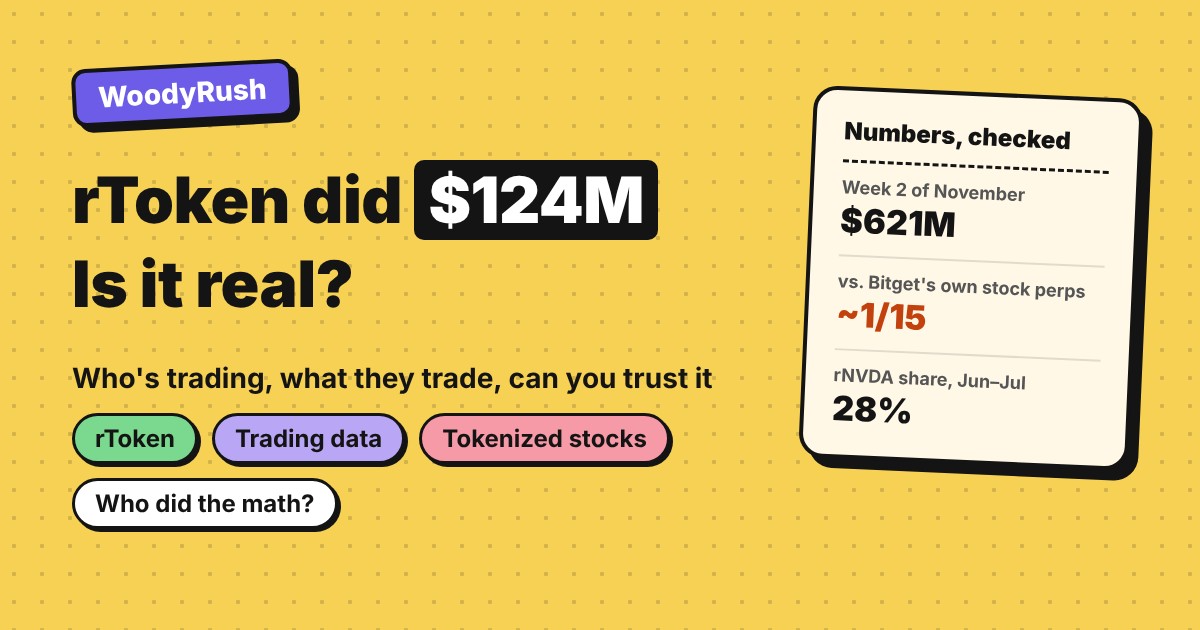
On November 17, Bitget’s official account posted that rToken daily volume broke $124 million, with cumulative growth of 366% over the past four weeks.
An exchange publishing numbers about its own product doesn’t prove much on its own. So this post isn’t about how good the product is. It answers three questions: Can the number be verified? Who is trading? What are they trading?
This post is research and personal judgment, not investment advice. Unless stated otherwise, the data comes from self-reported figures by Bitget or its affiliate Reality. I note the source for each figure and whether it can be verified.
The short version
- Treat the numbers with about half confidence: nearly all trading data is published by Bitget itself. On-chain data can’t verify it, because the tokens mostly sit in issuer and exchange addresses, and trades between users happen on the exchange’s internal ledger. All I can do is cross-check, and the figures are consistent with each other.
- People are trading, not holding: the latest week’s volume was about $621 million, against TVL of a little over $200 million. That’s the whole pool turning over roughly 3 times a week.
- What they trade is highly concentrated: almost entirely AI and semiconductors. In the first seven weeks, rNVDA alone made up 28% of volume, the top five were all chip stocks, and Tesla was under 2%.
- The traders aren’t mostly small retail: over 100,000 people had traded by early July, but rNVDA’s 8,074 traders averaged about $40,000 in volume each. Volume comes mainly from a small group of active traders (very likely market makers too), not lots of small recurring buys.
- Inside Bitget’s own US stock business, it’s still small: Bitget’s stock perpetuals did about $122 billion in Q3, or over $9 billion a week. rToken’s record week is roughly 1/15 of that. On this exchange, most people trading US stocks still use futures.
1. Where the number comes from, and whether it can be verified
What the official sources say
Here are the figures published over the past few months, in order:
| Date | Data | Source |
|---|---|---|
| June 2 | rToken launches | Bitget |
| As of July 6 | AUM about $114M; cumulative volume $671M; average daily $19.75M; peak day $56.16M; over 100,000 users had traded | Bitget blog (July transparency report) |
| June 2 to July 19 | Cumulative volume $1.16B | DefiLlama research report |
| Second week of November | Weekly volume $621M, of which rNVDA $139M; TVL above $200M | Reality, via TechFlow |
| Posted November 17 | Daily volume above $124M; weekly volume up 366% cumulatively over four weeks | @Bitget_zh |
The $124M post leaves out three things: which day the figure is for, which week is the baseline for 366%, and whether futures traded using rToken as margin are included.
Can you check it on-chain? Not really
rToken is an on-chain token on Arbitrum, so in theory you could look up holders and transfers. In practice:
- On rwa.xyz, a third-party data platform, rRTX and rTTD each show only 2 holder addresses (snapshots from late October to early November).
- An investigation by on-chain data firm Bitquery found that tokenized stocks on Arbitrum are overwhelmingly concentrated in a few issuer addresses, with Reality among them.
So rToken’s on-chain footprint is mostly inventory. User trades on Bitget are recorded on the exchange’s internal ledger and don’t each go on-chain. That means on-chain data can neither prove nor disprove the $124M. This isn’t unique to Bitget: most tokenized stocks on centralized exchanges work the same way.
What you can do: cross-check
There’s no independent audit, but several figures can be checked against each other:
- The 366% works backwards: if the latest week was $621M, 366% growth means the week four weeks earlier was about $133M, or around $19M a day. That roughly matches the $19.75M daily average Bitget published in early July. In other words, rToken probably stayed near July levels until mid-October, then jumped in the past month.
- The daily and weekly figures fit: with $621M in a week across five US trading days plus a weekend, a peak day of $124M is plausible.
- The per-trader figure fits: the DefiLlama report has rNVDA at 8,074 traders and $325.3M in volume. That works out to about $40,300 per person, matching the per-user figure in the report.
One caveat: Bitget has heavily promoted the DefiLlama report. I couldn’t confirm whether Bitget commissioned it, and the underlying data it uses also comes from Bitget.
My take: the numbers are internally consistent with no obvious contradictions, but none of them were computed from raw data by an independent third party. Read them as “the trend according to the exchange,” not as audited fact.
2. What they trade: almost all AI and chips
By volume: the top five are all semiconductors
The DefiLlama report covers June 2 to July 19:
| Token | Underlying stock | Volume | Share |
|---|---|---|---|
| rNVDA | NVIDIA | $325.3M | 28.0% |
| rMU | Micron | $61.0M | 5.25% |
| rDRAM, rSNDK, rMRVL | Memory and chip-related | — | — |
| Top five combined | $540.9M | 46.6% | |
| rTSLA (10th) | Tesla | $22.8M | 1.96% |
A few observations:
- Single-stock concentration is high: rNVDA alone is close to 30%. In the second week of November it still did $139M, about 22% of that week.
- Memory chips are the second theme: Micron (MU) and SanDisk (SNDK) both sit in the AI memory supply chain, and Bitget’s own articles promote them as popular trading picks. I couldn’t find an official description of what rDRAM tracks.
- Tesla is surprisingly small: one of the most popular US stocks among retail traders ranks only 10th here.
- Index funds aren’t the main act: rSPY trades, with a tight spread, but isn’t in the top five.
By holdings: a different leaderboard
Rank by holdings (AUM) instead of volume, and as of July 6 the list looks completely different: rSPCX (SpaceX) at 23.51%, rCSCO (Cisco) at 17.75%, rNVDA at 13.38%.
The gap between the two lists suggests to me that what people trade and what people hold are different things. rNVDA is for getting in and out. The top holdings are there for other reasons. For example, Bitget ran a $1 million rSPCX giveaway (I couldn’t find the exact dates), and tokens handed out in a campaign count directly toward holdings. Cisco’s large share may reflect a few big holders, but Bitget hasn’t published holder distribution, so this is speculation.
3. Who is trading: a few active traders, not a crowd of small retail
Bitget hasn’t published a user profile, but the available data sketches a rough picture:
1. The user count isn’t small, but volume is concentrated. As of July 6, more than 100,000 people had traded rToken, with $671M in cumulative volume, an average of about $6,700 per person. Over a similar period, rNVDA traders averaged about $40,000 each. The two figures come from slightly different windows and sources, but the direction is clear: most users trade very little, and volume comes mainly from a small group of high-frequency, high-size traders. Some of those 100,000 “who have traded” probably only showed up for a campaign.
2. They’re trading, not holding. The latest week had $621M in volume against TVL of a little over $200M, a turnover of about 3 times a week. Genuine buy-and-hold investors can’t produce that kind of turnover.
3. A lot of trading happens while the US market is closed. A Bitget article says rNVDA did $38.5M on August 26, with more than a third outside regular US trading hours. Industry-wide, a secondary summary of RedStone’s tokenized stocks report says about 55% of tokenized stock volume happens outside regular US hours. That fits with Asian users trading US stocks during their own daytime.
4. Tight spreads mean professional market makers are present. Bitget’s liquidity report puts rNVDA’s bid-ask spread at about 0.5 basis points. DefiLlama recorded a median spread of about 0.83 basis points across Bitget’s five tokenized stock markets. Retail traders posting orders against each other can’t produce spreads that tight; there have to be market makers quoting both sides, and their trades count toward volume too. Bitget hasn’t said how much of the volume comes from market makers.
5. US users aren’t in the picture. US persons and users located in the US generally can’t use rToken. The community discussion I found was mostly in Chinese, but that’s partly because I searched mainly with Chinese keywords, so it says little about who the users actually are.
My take: rToken’s core users are crypto traders already on Bitget, trading AI and chip stocks on the side inside the exchange. They trade often, in size, and frequently outside US market hours, with market makers providing liquidity. That’s a different thing from “regular people starting to invest in US stocks long-term via blockchain.”
4. Seen inside Bitget’s own US stock business
To judge whether $124M is big or small, the best benchmark is Bitget’s other US stock product: stock perpetual futures.
According to TokenInsight’s Q3 report (via TechFlow), Bitget’s stock perpetuals did about $122 billion in Q3, third among centralized exchanges with a 7.6% market share. That’s roughly $9.4 billion a week.
| Product | Weekly volume (approx.) |
|---|---|
| Bitget stock perpetuals (Q3 weekly average) | $9.4B |
| rToken (record week in November) | $621M |
rToken’s best week is roughly 1/15 of an ordinary stock-perp week. The same holds across the industry: spot trading in tokenized stocks is far smaller than trading in stock perpetuals.
So a more accurate way to put it: lots of people do trade US stocks on exchanges, but most of them use leveraged futures, not 1:1 spot tokens like rToken. rToken is growing fast because it’s starting from a small base.
5. The unified account: what it does, without overselling it
The feature that gets the most attention: in Bitget’s unified account, rToken holdings count toward margin for USDT-margined futures at a discount. So while you hold rNVDA, that asset can support futures positions, and you don’t have to split your money in two.
Two things to say plainly:
- This isn’t new. Traditional brokers like Interactive Brokers (IBKR) also let you use stocks as margin for futures and options in a portfolio margin account. The only difference with rToken is that it sits in the same account as crypto futures.
- The risks are linked. If your futures lose money, your rToken holdings can be liquidated along with them. Weekend rToken prices come from Bitget’s internal liquidity with no stock price to anchor to; if the stock gaps at Monday’s open, your margin value can change sharply in an instant. Check the exact haircut in the app before opening a position.
A community member specifically warned about this, and another user wrote that they only buy spot without leverage precisely to avoid liquidation.
6. It’s not a stock, and that hasn’t changed
However big the volume gets, none of this changes:
- You don’t hold a stock. Reality’s terms of service define rToken as a tokenized debt instrument issued by the issuer. Holders don’t directly own the underlying stock and have no voting rights. Besides price risk, you carry the issuer’s credit risk.
- Custody has two layers. The official FAQ says Alpaca holds the underlying 1:1; the terms name MRL as custodian, with shares held in MRL’s account at Alpaca.
- “Licensed” depends on who holds the license. Bitget’s clarification notice states that the New Zealand license belongs to MRL, not Bitget, and that MRL isn’t responsible for Bitget’s crypto trading.
- Weekend prices have no stock anchor. Weekend fills come from Bitget’s internal liquidity and converge to the real stock at Monday’s open.
- Regional restrictions can change at any time. US users were never eligible, and rules elsewhere can shift.
I break down the full chain in the next post.
Final thoughts
Back to the three questions.
Are the numbers real? They can’t be independently verified, but the official figures are consistent with each other. I lean toward believing the trend is real: rToken volume really did grow several times over in the past month.
Who is trading? Mainly crypto traders already on Bitget. There are a fair number of them, but volume is concentrated in a small set of high-frequency, high-size accounts, with market makers behind the liquidity.
What are they trading? AI and chip stocks, especially NVIDIA, mostly on a short-term basis.
So rather than “RWA has finally arrived,” a better summary is: crypto traders on an exchange found a new tool for trading AI stocks with USDT. That’s a real demand, but it’s a long way from “regular people holding US stocks long-term on-chain.”
If Bitget wants these numbers to be more convincing, the most direct step would be publishing more raw data: unique users and holding distribution, the share of volume from market makers, weekend price deviation from the underlying stock, and a reconciliation of on-chain reserves against token supply. Until then, whenever you see a “new record” like this, ask one question first: who calculated it?
Sources: Bitget official post (Chinese), Bitget rToken AUM report, Bitget tokenized equity liquidity report, DefiLlama research report, TechFlow: rToken weekly volume $621M, TechFlow: TokenInsight Q3 stock perpetuals report, rwa.xyz: rRTX, rwa.xyz: rTTD, Bitquery: Arbitrum tokenized asset investigation, RedStone tokenized stocks report, Reality terms of service, license clarification notice. Data gathered through November 18, 2026.