The previous post checked rToken’s trading data: whether it’s real, who is trading, and what. This one does a single job: take apart, layer by layer, what happens after you tap “Buy rNVDA.”
By the end you should be able to answer four questions. Where does the money go? Where is the stock held? What does the token in my account actually represent? And who’s responsible if something goes wrong?
This post is research, not investment advice. It’s based on official Bitget and Reality documentation. Where the official docs don’t say something clearly, I’ll point that out.
The whole chain in one diagram
1. Who’s in the chain
First, meet each party in the diagram. Every process below is just these parties handing things to each other.
| Role | Who | What they do |
|---|---|---|
| Bitget | The exchange | Gives you the order screen, matches trades, shows your holdings; provides liquidity on weekends and US holidays; lets rToken count toward margin in the unified account |
| Reality | An RWA issuance platform strategically backed by Bitget | Issues rToken, minting on buy and burning on sell; pays dividends and other proceeds to holders under contract |
| Alpaca Securities | A licensed US self-clearing broker-dealer, FINRA registered and SIPC member | Brokerage and clearing; during US market hours, routes orders to the Nasdaq and NYSE order books |
| MRL (Mana Remittance Limited) | The custodian defined in Reality’s terms | Holds the underlying shares in its account at Alpaca; also holds New Zealand license FSP1011615 |
| Arbitrum, Morph | Blockchains | The chains rToken launched on, where the tokens are recorded |
One point is easy to get wrong: who actually holds the stock?
- The official FAQ says the underlying US stocks and ETFs are held 1:1 by Alpaca.
- Reality’s terms of service say the Custodian is MRL and the Broker-Dealer is Alpaca, with underlying assets held through the custodian’s account at the broker.
- The broker transfer guide matches this: shares go to Alpaca’s designated omnibus account, and the receiving account name is MRL.
These two descriptions don’t conflict. They describe different layers: the shares physically sit at Alpaca, and the account belongs to MRL. So “held by Alpaca” and “held by MRL” are each incomplete on their own.
Bitget has also published a clarification notice stating that MRL is not part of the Bitget group or exchange, and is not responsible for Bitget’s crypto trading.
Who sits on which side
Regroup the parties by whose interests they share, and the picture gets clearer:
- Bitget’s side: the exchange is Bitget, the issuer Reality is strategically backed by Bitget, and weekend and US-holiday liquidity comes from Bitget internally. In other words, the party selling you the token, quoting you a price, and trading against you on weekends is essentially on the same side.
- The independent party: Alpaca is the only licensed institution in the chain with no corporate tie to Bitget.
- You are not Alpaca’s customer: Alpaca’s FINRA registration and SIPC membership protect its customers, and the Alpaca account belongs to MRL, not you. You have no direct claim on the underlying shares, and the official docs don’t say whether broker customer protections like SIPC apply to you personally.
So when marketing mentions “a licensed US broker” or “SIPC member,” keep in mind that it describes one layer of the chain, not a relationship between you and Alpaca.
2. What happens when you buy rNVDA
During US market hours (solid lines)
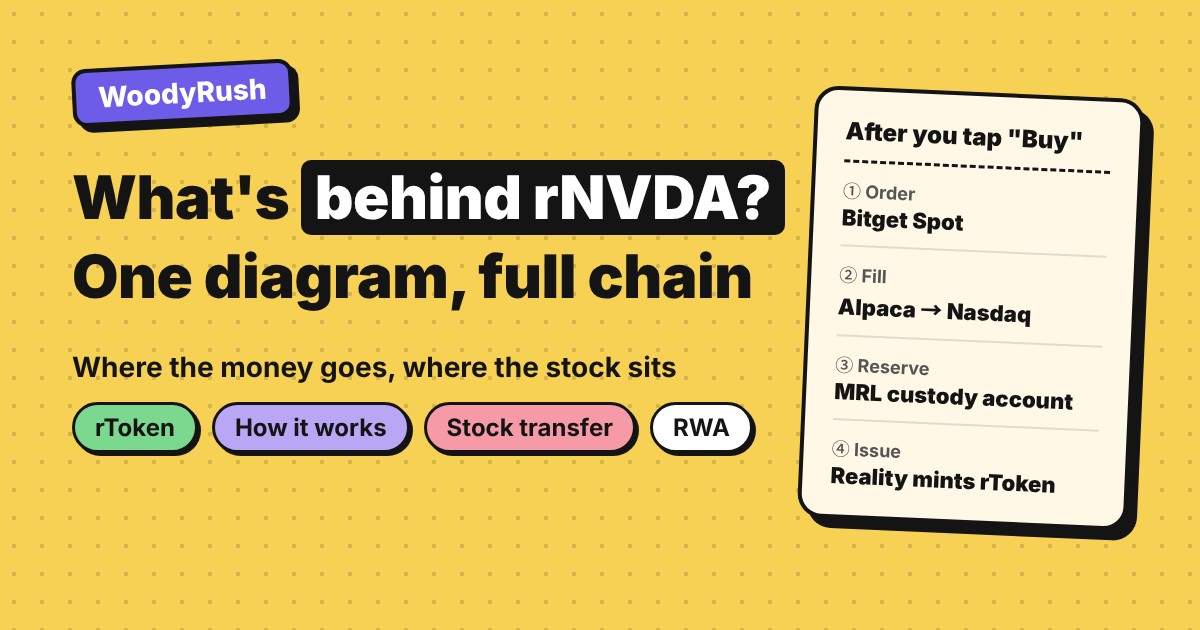
According to the official description, the process goes like this:
- You place an rNVDA order with USDT in Bitget spot.
- Alpaca routes the order to the Nasdaq and NYSE order books, where it fills.
- The matching NVDA shares go into MRL’s account at Alpaca as reserves.
- Reality mints the same quantity of rNVDA, and your Bitget spot account shows the position.
The official docs give two principles: “route to US order books during market hours” and “mint on buy, burn on sell.” They don’t say exactly when each order is minted, or whether hedging happens order by order or in batches. So the sequence above is the logical order implied by those principles, not a published timeline.
One more point that’s easy to misread: the rNVDA in your account is a balance on Bitget’s internal ledger, not an on-chain token sitting in your own wallet. As I found in the previous post, rToken has very few holder addresses on-chain; the tokens sit mostly in issuer and exchange addresses. Trades between users are recorded on the exchange’s books and only go on-chain when someone withdraws. That also means there’s no way to verify from the outside that every purchase was actually hedged in the US market.
Weekends and US holidays (orange dashed line)
When the US market is closed, there’s no Nasdaq order book to route to, so Bitget provides liquidity internally. You can still place orders and get filled, but keep two things in mind:
- The price has no stock anchor. Weekend rNVDA prices are matched inside Bitget and reflect the market’s expectation of Monday’s open, not a live NVDA price.
- It converges on Monday. If big news breaks over the weekend and the stock gaps at Monday’s open, rToken moves toward the stock price. Weekend buyers may profit from that gap, or lose on it.
How the underlying reserves are topped up on Monday after weekend trades isn’t publicly documented.
Selling
Selling is the reverse: you sell rNVDA for USDT, and the matching rToken is burned. During market hours the sale fills in the US market through Alpaca; on weekends it goes through Bitget’s internal liquidity.
3. What your rNVDA actually represents
This is the question people ask most in the community, and the one that most needs a straight answer.
rNVDA is not an NVIDIA share registered in your name. The official descriptions:
- Bitget FAQ: rToken is a tokenized certificate of beneficial interest in a US stock or ETF. It isn’t a stock registered to the user and has no voting rights.
- Reality’s terms of service: rToken is a tokenized debt instrument issued by the issuer. Unless Reality states otherwise in writing, holders don’t directly own the underlying stock.
In plain terms: you have a contract with Reality. Reality promises that rNVDA tracks NVDA’s price and that it will pass the corresponding economic benefits to you. The underlying shares are there as reserves to back that promise.
That means you carry two kinds of risk:
| Risk | Where it comes from |
|---|---|
| Market risk | NVDA’s own price moves, same as holding the stock |
| Issuer and intermediary risk | Whether Reality honors the contract, whether custody at MRL and Alpaca is sound |
| Exchange risk | rToken in your Bitget account is held by Bitget; if the exchange runs into trouble, freezes your account, or changes its rules, it affects you directly |
| Rule and regional risk | Platform rules, regional availability, and withdrawal channels can change at any time |
Buying the actual stock mainly carries the first kind, plus your broker’s own risk. Buying rToken carries all of them. What you get in exchange is weekend trading, USDT settlement, and shared margin with futures. Whether that trade-off is worth it depends on whether you actually need those features.
4. How dividends, splits, and other corporate actions work
Cash dividends
When the company pays a cash dividend, rToken holders receive USDT:
- A 30% US withholding tax is deducted first. This is the default rate and doesn’t change based on your country or region.
- The remaining 70% is paid to your account in USDT.
Example: if a stock pays a $1 dividend per share and you hold 100 of the matching rToken, you receive 100 × 1 × 70% = 70 USDT.
There’s a detail in the terms worth noting: this payment is “distributable net proceeds” paid by the issuer under contract. It isn’t the same as having a dividend claim against the listed company itself. Normally the amount is identical, but the legal relationship is different: your counterparty is Reality, not NVIDIA.
Stock dividends
If the company pays out shares, Reality issues the matching quantity of additional rToken to your account.
Splits and reverse splits
Quantity and unit price adjust automatically, and total value stays the same. If a stock does a 10-for-1 split and you held 10 tokens at 1,000 USDT each, afterward you hold 100 at 100 USDT each. You don’t need to do anything.
Voting
No voting rights. Shareholder meetings and votes don’t involve rToken holders.
5. Moving shares in from a broker: know what you give up first
rToken lets you transfer US stocks from another broker without selling them first. The official terms: whole shares of US stocks and ETFs only, sent by FOP (free of payment) to Alpaca’s designated omnibus account in MRL’s name, arriving in about 5 to 10 business days and then minted into rToken. Transferring in is free; transferring out of Bitget costs $150. The steps are in Bitget’s transfer guide.
The pitch is “bring your shares on-chain without selling,” but before you move anything, be clear that the asset changes nature:
| Before transfer | After transfer | |
|---|---|---|
| What you hold | Shares registered in your name | A contractual claim on Reality |
| Voting rights | Yes | No |
| Dividends | Withheld according to your tax status | Flat 30% withholding |
| Broker customer protection | You are the broker’s customer | You are not Alpaca’s customer |
| Cost to move out | Broker-to-broker transfers usually follow a standard process | $150 to transfer out of Bitget |
Free to move in, paid to move out: that asymmetric fee structure is itself designed to keep assets on the platform. If you’re moving shares in just to use them as margin now and then, or to trade on weekends, work out first how much it will cost and how long it will take to move them back.
6. The on-chain layer
rToken is issued on-chain, launched on Arbitrum and Morph:
- Supported rTokens can be deposited to and withdrawn from Bitget, and traded in compatible Web3 apps.
- Tokens are minted on buy and burned on sell, so on-chain supply moves with user activity.
- Withdrawals aren’t on by default. It depends on the specific token, your account, your region, and whether the channel is open.
- When you trade inside your Bitget account, your position is recorded on the exchange’s books, not on-chain. On-chain, rToken holder addresses are highly concentrated: on rwa.xyz, for example, rRTX shows just 2 holder addresses. So for now, “on-chain issuance” is mostly a settlement method between the issuer and the exchange. Ordinary users trading on the exchange don’t get the transparency of the chain.
One more warning: Bitget’s official pages don’t currently publish rToken contract addresses. If you see a token on-chain calling itself rNVDA, don’t buy it on the name alone. Anyone can deploy a token with the same name. Before withdrawing or trading on a DEX, confirm the contract address through Bitget’s official channels.
7. How rToken differs from real stocks and stock perpetuals
rToken isn’t Bitget’s only US stock product. According to Pence’s breakdown, Bitget also offers Stock+ (which he describes as real stock via RQD Clearing), plus stock perpetual futures. Roughly, the differences look like this:
| Real stock | rToken | Stock perpetual | |
|---|---|---|---|
| What you hold | A registered share | The issuer’s tokenized certificate | A futures position |
| Voting rights | Yes | No | No |
| Cash dividends | Yes | Paid in USDT after withholding | None |
| Weekend trading | No | Yes (internal liquidity) | Depends on platform rules |
| Leverage | Depends on broker | Spot has none, but usable as futures margin | Yes |
| On-chain | No | Some tokens | No |
| Your counterparty | Your broker | Reality and Bitget | Bitget |
| Main extra risk | Broker risk | Issuer, exchange, weekend pricing | Leverage, liquidation, funding rates |
The stock perpetual column describes how perpetual futures generally work. Check the platform’s futures pages for actual funding rates, trading hours, and leverage limits.
The three solve different problems: a real stock is ownership, rToken is the convenience of price exposure inside an exchange, and a perpetual is a leverage tool. If your goal is to hold US stocks long-term, most of the convenience rToken offers is something you won’t use. If you already trade on an exchange, it saves you opening an account and converting currency, at the cost of a few extra counterparties.
FAQ
Will rToken trade far from the real stock price? During US market hours, orders route through Alpaca to real order books, so the gap should in principle be small. On weekends there’s no stock anchor and deviations are more visible. Bitget’s own liquidity report puts rNVDA’s bid-ask spread at about 0.5 basis points, but that’s the exchange’s own figure. I couldn’t find any raw, timestamped screenshot showing rToken and the stock quoted side by side at the same moment, so I can’t give you an independently verified spread number. The most practical step is to check order book depth and the bid-ask spread before you trade.
If something happens to Bitget or Reality, is my stock still there? The underlying shares are held in MRL’s account at Alpaca, which is structurally separate from the exchange’s assets. But what you hold is a contractual claim on Reality, not a directly registered share. What happens in a failure depends on Reality’s terms and the laws where each party sits. The official docs don’t describe a specific resolution process.
Who can use it? US persons and users located in the US generally can’t. For mainland China, the official FAQ says users who meet identity verification, regional, and product requirements “may be able to” use it, depending on account status at the time. Check what your own account shows.
Why 30% withholding on dividends? Doesn’t my country’s tax treaty apply? The docs state that 30% is the default withholding rate and doesn’t change based on where you live. So even if your country has a lower treaty rate with the US, you won’t get it on rToken.
Final thoughts
Once you take the chain apart, rToken fits into one sentence: the exchange handles the experience, the broker handles execution, the custodian holds the reserves, the issuer makes the promise, and the blockchain keeps the record.
Its convenience comes from that division of labor, and so do its risks. In the app you see a ticker and a price, but behind it every layer has someone doing a job, and every layer can fail.
Understanding the chain isn’t about convincing you to buy or not buy. It’s so that next time someone tells you “this is just a US stock” or “this is vaporware,” you can tell which layer they’re talking about.
If you haven’t read the previous post, start with rToken did $124M in a day. Is it real?. It checks whether the trading data can be trusted, who is trading, and what they trade.
Sources: rToken FAQ, Reality and Alpaca partnership announcement, Reality terms of service (October 28, 2026 version), Bitget Wallet Reality page, rToken on-chain announcement, rToken transfer guide, Tiger Brokers transfer guide, license clarification notice.