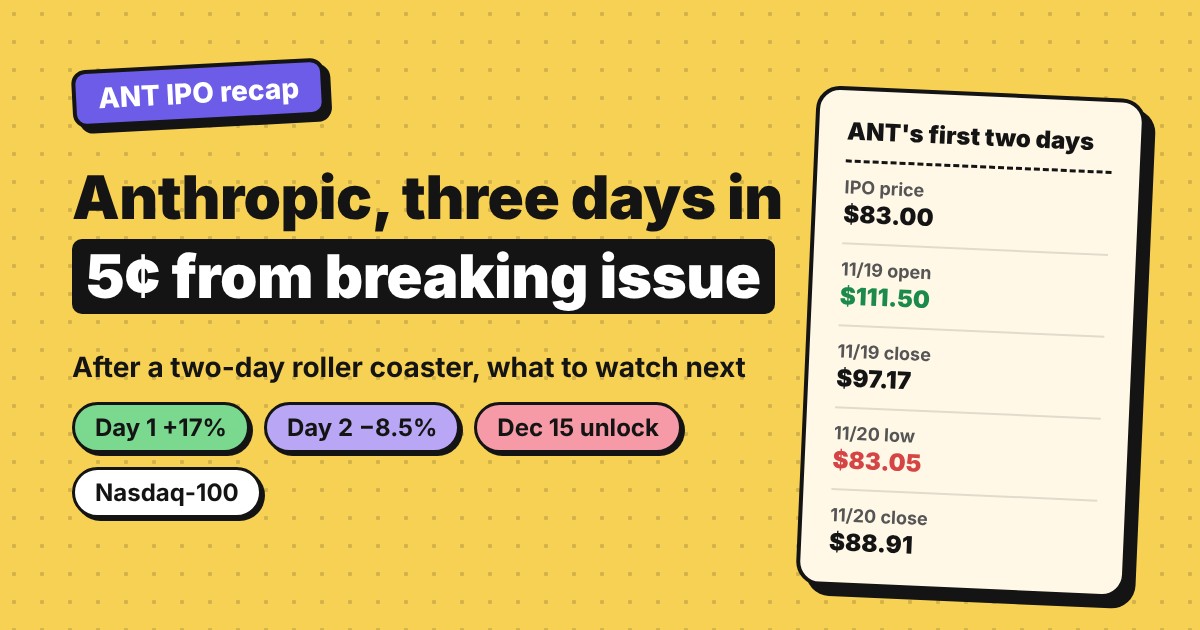
On Friday afternoon, ANT fell to $83.05. The IPO price was $83. The largest IPO in history came within five cents of breaking issue on its second day of trading.
Then it bounced, closing at $88.91. This post walks through those three days from the start: how the money was split, how the price moved, and what to watch over the next few months.
This post is research, not investment advice. Data is as of the close on Friday, November 20, from public reporting; sources are listed at the end. Figures marked “rough math” are my own arithmetic. For background, see How to buy the Anthropic IPO and Anthropic’s valuation, broken down.
The short version
- IPO price $83, day-one close $97.17, day-two close $88.91. Three calendar days and two trading sessions after listing, it sits 7% above the IPO price.
- The two-day drop was mostly the AI sector falling. There was no new fundamental news about Anthropic itself.
- The real tests come later: December 15, when up to 303 million shares unlock; December 21, the expected Nasdaq-100 inclusion; and early next year, the first earnings report as a public company.
- My expectation: the stretch around December 15 will be the weakest. Whether it holds $83 matters far more than these first two days.
Day one: the open was the high
On the evening of November 18, Anthropic priced its IPO at $83, above the original $70 to $78 range, and raised the share count from 825 million to 980 million. With demand running close to seven times the offering, that price wasn’t a hard sell.
Close to noon Eastern time the next day, the first trade printed: $111.50, 34% above the IPO price. It then touched $115.10, briefly pushing the market value above $2 trillion.
From there, it was downhill.
| November 19 | Price | vs. IPO price |
|---|---|---|
| IPO price | $83.00 | — |
| Open | $111.50 | +34% |
| High | $115.10 | +39% |
| Low | $92.72 | +12% |
| Close | $97.17 | +17% |
About 857 million shares traded on day one, close to the size of the entire IPO. In other words, a large share of the people who got stock at the IPO price sold it the same day.
Why such a high open? Far more people wanted shares than got them. Bloomberg reported that about 1,200 institutions placed orders and most received nothing. Retail investors were allocated about 15% in total; one Robinhood user who requested 200 shares got 4. All that unfilled money rushed in at the open and lifted the price to $111.50. Once that wave of buying was absorbed, there was no one left to take the other side.
This is the old script for mega-IPOs. SpaceX rose 19% on its first day five months ago. Anthropic rose 17%, nearly the same.
Day two: five cents from breaking issue
Friday opened at $89.86, 7.5% below the previous close. The intraday low was $83.05; then it rebounded to close at $88.91, down 8.5% on the day.
That looks bad, but put it in the context of that day’s market:
| November 20 | Change |
|---|---|
| Nvidia | about −14% |
| AMD | about −13% |
| Broadcom, Micron | about −12% to −14% |
| Anthropic | −8.5% |
The whole AI sector was collapsing that day. Nvidia’s CEO Jensen Huang had just stepped down, and there were reports that the SEC was examining its accounting (I haven’t seen official confirmation). AMD was targeted by a short seller. Expectations of rate hikes were rising, and the market started worrying that trillions of dollars of data center buildout wouldn’t find cheap financing.
None of this happened to Anthropic. Its revenue, customers, and compute contracts were the same numbers on Thursday and Friday. So I don’t think these two days mean “the market rejected Anthropic.” A more accurate reading: it picked the worst week for the AI sector to go public, and it held the IPO price.
The $83 line matters because it’s every IPO buyer’s cost basis. If it breaks, “largest IPO ever breaks issue” becomes the headline, and people who planned to hold will want out. It held on Friday, but only once.
The money is already banked: $119.5 billion, and $1.96 billion for the founders
The stock is wobbling, but the money has landed. At Friday’s settlement, the underwriters exercised the full overallotment option of 147 million shares. You’ll see several different numbers in the media; they’re just different bases:
| Basis | Shares | Amount |
|---|---|---|
| Base offering | 980 million | $81.34 billion |
| Plus overallotment | 1.127 billion | about $93.5 billion |
| Plus concurrent private placement | about 313 million additional Class N shares | about $119.5 billion in total |
From the public offering, the company itself received about $91.6 billion. The $26 billion private placement came from investment entities of AMD, Broadcom, Google, Micron, Microsoft, Nvidia, and TSMC. There had been worries that Nvidia might pull out; in the end, it stayed on the list.
Of the 980 million base shares, 23,648,646 weren’t issued by the company. They were sold by the seven co-founders: about 3.38 million shares each, about $280 million each, roughly $1.96 billion in total. That money goes to the individuals; the company gets none of it.
Chinese-language media came down hard on this, some even listing it as a reason for the decline. I think the two issues need to be separated.
The claim that it caused the drop doesn’t hold up. These shares were sold to new shareholders in the IPO at $83, all at once, not in the secondary market. The proportion is also small: just 2.4% of the base offering. Dario Amodei reportedly sold about 1.4% of his personal stake; what’s left is still worth more than $20 billion and is locked up for a year.
The people actually selling in the secondary market are a different group. The prospectus lets employees and executives sell up to 10% of their holdings starting on day one, capped at about 315 million shares, more than 13 times what the founders sold. There’s no public breakdown of how much of day one’s 857 million shares traded came from them, but that’s the selling worth watching.
What deserves discussion is governance. The founders took cash; a single Class F share retains 50.1% of the voting power, and CNBC, citing the prospectus, puts the founders’ combined voting power at about 61.3%; and the pledge to “donate 80% of their holdings” is, per the prospectus, revocable and not legally binding. Cash taken, control kept, and the pledge can be withdrawn at any time. Taken together, those three facts are what ordinary shareholders should care about.
What it’s worth now
At Friday’s close, the fully diluted market value is about $1.61 trillion (rough math), roughly 20 times annualized revenue. The company hasn’t published an official market cap, and media figures vary widely: based on shares outstanding, Thursday’s close was about $1.17 to $1.28 trillion; fully diluted, about $1.75 to $1.8 trillion. When you see a market cap, check the basis first.
Analysts have already split into two camps.
The bulls: Melius at $155, Needham at $150, Wolfe at $135, Citizens at $125, and William Blair with an outperform rating. Their logic is straightforward: revenue for the first three quarters was $33.2 billion, up 12 times year over year, and annualized revenue was about $81 billion at the end of October. At that growth rate, 17 to 20 times revenue “isn’t outrageous.”
The cautious side: Morningstar puts fair value at $92, almost exactly the current price. Seaport rates it neutral with no price target, saying the company is strong but the valuation requires investors to “make a big leap.” IPO researcher Jay Ritter points out that based on actual trailing 12-month sales, the multiple is about 40 times.
Both camps are really arguing about the same question: Q3 grew 47% quarter over quarter, versus 144% the quarter before. Is that a temporary slowdown, or the new normal?
Keep the other side of the ledger in mind too. The prospectus discloses about $900.9 billion in purchase and lease commitments, mostly related to compute, with about $70.7 billion due within a year. Roughly $81 billion of annualized revenue sits against nearly $1 trillion of compute commitments. The market will need time to find a stable price between those two numbers.
A side note: crypto’s $870 million
I wrote earlier about subscribing to the IPO with USDT, so here are the results. Five platforms collected about $870 million in subscriptions:
| Platform | Shares received | Allocation rate |
|---|---|---|
| Bitget public round | 16,280 | about 1.3% |
| Gate | 92,100 | about 5% overall |
| Bitget VIP round | 137,494 | about 10.06% |
| Binance Wallet | about 2,957 | extremely low; full refunds |
| Kraken | partial allocation confirmed | not disclosed |
The good news: there was no repeat of SpaceX, where several platforms got zero. The bad news: allocation rates were tiny. A $10,000 order through a public channel made only $3 to $11 at Friday’s close (rough math). The VIP round got the most shares, but its 12% fee meant it was already down about $49 at Friday’s close.
IPO returns depend on how much you’re allocated, not on how much the stock rises. I said that once before pricing; now there are actual numbers behind it. The detailed table is here.
On the sidelines: what OpenAI is waiting for
The most attentive watcher of these three days may have been OpenAI.
It confidentially submitted a draft IPO filing to the SEC in June but hasn’t set a date. CFO Sarah Friar told employees in August that the company would list in 2027 or sooner, and that there was no need to worry about Anthropic going first. On November 18, the day Anthropic priced, Sam Altman said at the DealBook Summit that OpenAI won’t go public in 2026, that he isn’t worried about being beaten to market, and that staying private makes it easier to handle some safety issues.
That sounds relaxed, but according to foreign media reports, the target for OpenAI’s latest funding round has dropped from about $30 billion to about $20 billion, and the target valuation from $1.4 trillion to $1.25 trillion.
Anthropic’s listing means at least three things for OpenAI.
First, there’s now a yardstick for pricing. Before, both companies’ valuations were negotiated privately. Now ANT has a public price every day. When OpenAI lists, investors will apply ANT’s multiples to its revenue.
Second, whether the window is open depends on ANT. If ANT stays above its IPO price, it shows the market can absorb trillion-dollar AI IPOs. If it breaks below $83, OpenAI will either have to price lower or keep waiting.
Third, some of the money has already been taken. This deal plus the private placement raised about $119.5 billion, and funds willing to bet big on AI have already committed a large chunk. Another deal of the same size will take time.
Under SEC rules, a company must make its prospectus public at least 15 days before the roadshow. So the earliest signal of an OpenAI IPO will be the day its S-1 goes public. Until then, ANT’s share price is the market’s only public answer to “what is an AI model company worth?”
Next: unlocks, the index, and the first earnings report
With the three days covered, here’s what comes next. I’ve laid out upcoming events in order, along with my expectations. These are judgments, not predictions.
Timeline
| Date | Event | Direction |
|---|---|---|
| November 23 | Options expected to start trading; 2x long (ANTT) and short (ANTZ) ETFs expected to launch | More volatility |
| November 30 | Nasdaq-100 ranking reference date | — |
| December 11 | Inclusion list expected to be announced | Leans positive |
| December 15 | Up to 303 million shares unlock | Leans negative |
| December 21 | Expected Nasdaq-100 inclusion | Leans positive |
| January 5 | Next unlock tranche | Leans negative |
| Early next year | First earnings report as a public company; a larger unlock follows the annual report | Depends on the numbers |
| Around mid-May 2027 | Day 180: most holders unlock; co-founders can sell up to 29% | Leans negative |
| Around November 2027 | Day 365: founders and major holders fully unlocked | — |
The options and index inclusion dates aren’t official announcements; follow exchange notices. The unlock dates come from third-party summaries of the prospectus, and I haven’t checked them against the final prospectus.
How big are the unlocks?
| Shares | At $88.91 (rough math) | |
|---|---|---|
| Current float | about 1.127 billion | about $100 billion |
| December 15 unlock | up to 303 million | about $26.9 billion |
| Between December 15 and February 2 | up to about 1.3 billion | about $116.6 billion |
| All locked-up shares | about 15.5 billion | — |
| Passive index fund buying (various estimates) | about 50 to 210 million | $4.6 to $19 billion |
Only about 1.1 billion shares can trade right now, while about 15.5 billion are locked up. Over the next year, the market will have to absorb these shares batch by batch.
My expectations
Until December 15: it follows the sector, and $83 will be tested again. The company has no new numbers to report, so the price will mostly take its cue from the AI sector. With options and leveraged ETFs launching next week, shorting gets easier and volatility will only rise. If the bad news around Nvidia isn’t over, $83 will very likely be tested again.
December 15 to 21: the weakest week. The unlock comes first, index fund buying after. December 15 releases up to 303 million shares in a single day, about 27% of the current float, while passive index buying, even on the most optimistic estimate, is only about 210 million shares, and won’t arrive until around the 21st. “Up to” is a ceiling and holders won’t necessarily all sell, but supply and demand are most out of balance in the week in between. One analyst has already published a piece titled “I’m waiting for Dec 15.”
A usable test. If the stock is still holding above $83 after December 15, the selling pressure was absorbed, which tells you far more than how much it rose on day one. If it breaks below the IPO price around the unlock, you’ll have to wait for earnings to reprice it.
Early next year: earnings decide who wins the valuation argument. This is the first report card as a public company. One number is enough: Q4 quarter-over-quarter revenue growth. Back to triple digits, and 20 times revenue gets absorbed quickly; the bulls win. Stuck below 50%, and Morningstar’s $92 becomes consensus. A larger unlock follows the annual report, so a weak report would hit at the same time.
Further out: May is the next big milestone. At day 180, most holders’ lockups expire, and the co-founders can sell up to 29%. By then, the float will be several times what it is now.
Five things to watch
- $83. The most direct indicator of short-term sentiment.
- Volume and price around December 15. Watch whether the unlocked shares find buyers.
- Q4 quarter-over-quarter growth. The number that decides the valuation multiple.
- The next model release. The prospectus says 80% of revenue comes from models less than six months old. If a model is late, revenue has a gap.
- When OpenAI’s S-1 goes public. Once it does, the two companies will be compared side by side.
Final thoughts
After three days, not much is certain: the money was raised, the overallotment was fully used, and the price came back from its high to just above the IPO price. What isn’t certain is how long the market will take to set a stable price for a company with about $81 billion of annualized revenue and nearly $1 trillion in compute commitments.
For ordinary investors, my advice is the same as before the listing, just with numbers behind it now: don’t chase the open, don’t expect to get rich from IPO allocations, and if you want to hold long-term, there’s no rush. Over the next two months there will be at least two clearer opportunities than now: one after the mid-December unlock, and one after the first earnings report.
FAQ
What is Anthropic’s stock price after the IPO?
The IPO price was $83. On November 19, day one, it opened at $111.50 and closed at $97.17; on November 20 it closed at $88.91, about 7% above the IPO price.
Did Anthropic break issue?
No. On November 20 the intraday low was $83.05, five cents above the $83 IPO price, but it didn’t break below it and closed back at $88.91.
Why did Anthropic stock fall?
Mainly because the whole AI sector fell. On November 20, Nvidia dropped about 14% and AMD about 13%, driven by Nvidia’s CEO departure, rate hike expectations, and worries about returns on AI investment. In addition, unfilled IPO demand lifted the open, and afterward there weren’t enough new buyers to take the other side.
When does Anthropic’s lockup expire?
Employees and executives can sell up to 10% starting on day one. The next tranche is December 15, up to 303 million shares; the one after that is January 5. Most holders unlock around day 180 (mid-May 2027), and founders and major holders are locked up for up to 365 days.
When will Anthropic join the Nasdaq-100?
Under the fast-entry rule, it’s expected to be announced December 11 and added at the open on December 21. Nasdaq hasn’t issued an official announcement yet.
How much stock did Anthropic’s founders sell in the IPO?
The seven co-founders each sold about 3.38 million shares, 23,648,646 in total, about $1.96 billion. That money goes to the founders personally, not the company. The founders still control 50.1% of the voting power through Class F stock.
What is Anthropic’s price target?
Published price targets range from $125 to $155, with one tally averaging about $133. Morningstar’s fair value estimate is $92, and Seaport Research rates it neutral with no price target.
When will OpenAI go public?
There’s no set date. OpenAI has confidentially submitted a draft IPO filing to the SEC; its CFO says it will list in 2027 or sooner, and Sam Altman says it won’t be in 2026.
When can I trade ANT options?
Expected to start as early as November 23; the exchange hasn’t formally confirmed.
Sources
- Stock price and first-day trading: Bloomberg, CNN, Forbes, CNBC, Fortune
- AI sector decline: Motley Fool, Charles Schwab, ifeng.com (Chinese), ChainCatcher
- Analyst views: CNBC, TipRanks, Yahoo Finance
- Unlocks and index inclusion: FourWeekMBA, Seeking Alpha, StockAnalysis, Saxo Bank
- Founders and OpenAI: Fortune, Forbes, CNBC, The Paper (Chinese), ifeng.com (Chinese)
- Allocations and crypto subscription results: Bloomberg, PANews, TechFlow, ifeng.com (Chinese)
This post is research, not investment advice. Data as of the close on November 20, 2026.