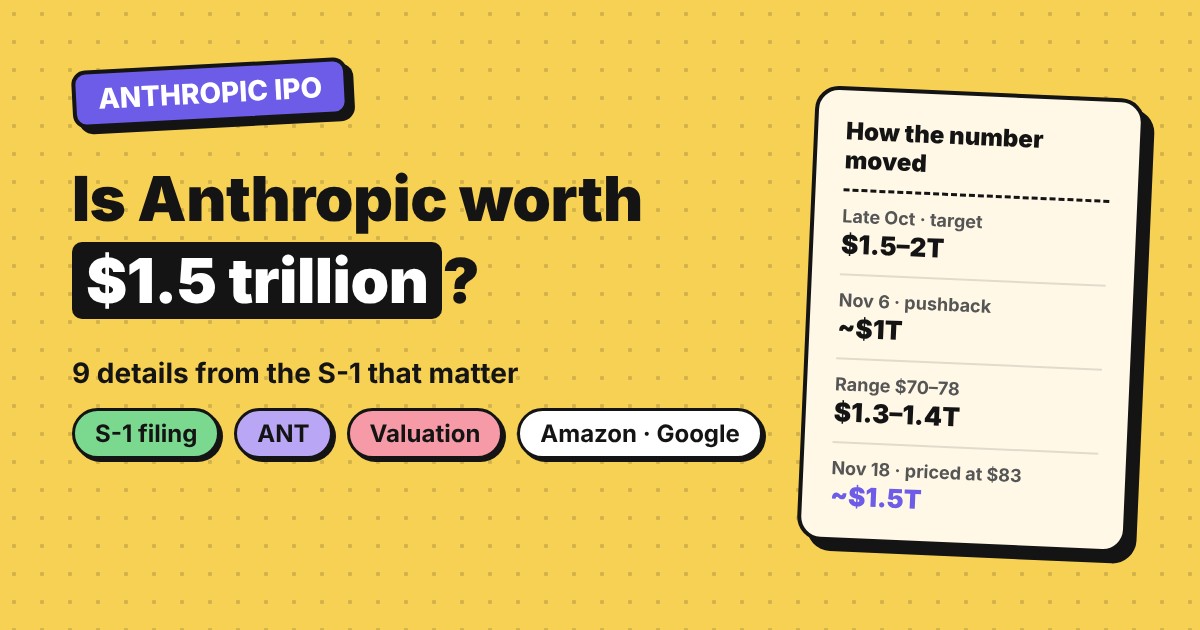
In three weeks, Anthropic’s IPO valuation went from a $1.5–2 trillion target, to investors pushing for about $1 trillion, and back to $1.5 trillion after orders reportedly came in at nearly seven times the shares on offer. On November 18 the IPO priced at $83.
This post does three things: lays out how the number moved, works out the valuation multiple from the prospectus, and walks through the 9 details that actually drive it. How to buy is a separate question: see How to Buy the Anthropic IPO.
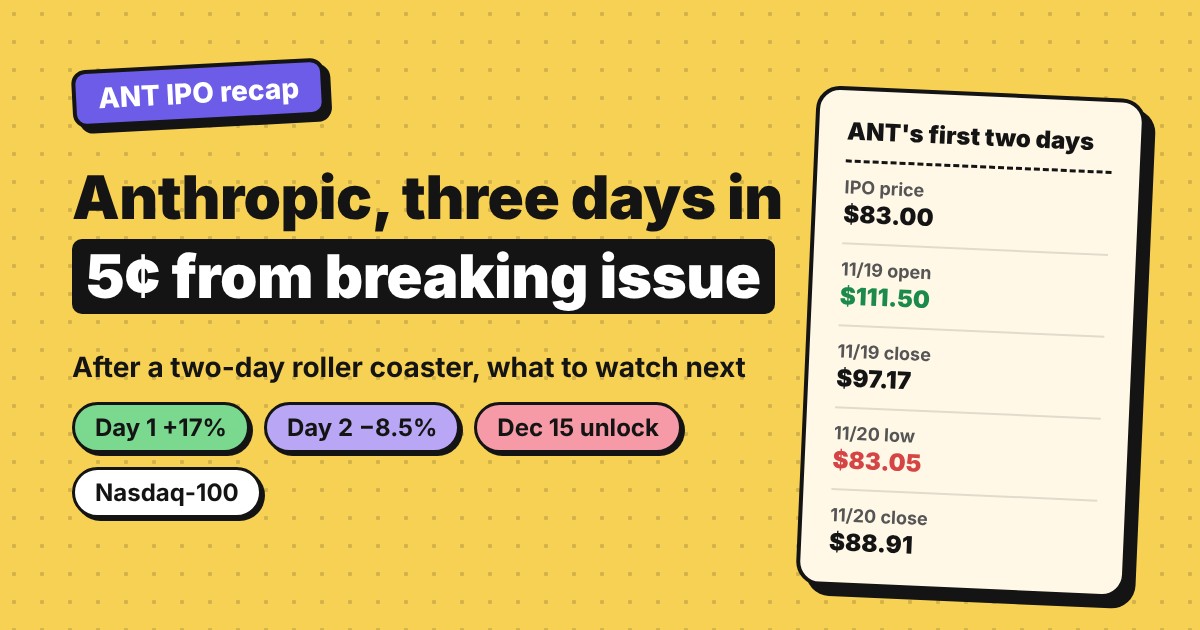
This is not financial advice. Financial figures come from Anthropic’s amended S-1 filed November 17 and the company’s IPO fact sheet. Anything marked “my math” is arithmetic I did on those numbers, not a company figure. Update, November 21: the IPO priced at $83, and the valuation and multiples below use that price. ANT opened at $111.50 and closed its first day at $97.17 (+17%), then closed at $88.91 on day two. See the three-day recap.
The short answer
- The valuation: the IPO priced at $83, above the $70–78 range, or about $1.5 trillion fully diluted. It raised $81.3 billion, the largest IPO on record.
- The revenue: about $17 billion in Q3 2026, up 1,127% year over year. Run-rate revenue was about $81 billion at the end of October.
- The multiple: on run-rate revenue, price-to-sales is about 18.5x, above NVIDIA (12.3x) and Microsoft (11.1x) and below Palantir (52.3x). On the last four quarters of actual revenue, it’s about 42.5x.
- What supports it: revenue grew 12x in a year, customer concentration is falling, and operations are close to breakeven.
- What weighs on it: quarter-over-quarter growth slowed from 144% to 47%, 80% of revenue depends on models less than six months old, and purchase commitments total $313.8 billion.
- What buyers should know: founders control 50.1% of the vote, there is no dividend, and employees can sell up to 10% of their holdings on the first day of trading.
Anthropic valuation timeline: two reversals in three weeks
| Date | Event | Valuation |
|---|---|---|
| May 28 | Series H raises $65 billion | $965 billion post-money |
| Oct 26 | Public S-1 filed; share count and price left blank | Not disclosed |
| Late Oct | WSJ: plans to raise $100 billion or more | $1.5–2 trillion target |
| Nov 6 | WSJ: investors say the target may come down | One says closer to $1 trillion |
| Range set | $70–78 per share | About $1.33 trillion at midpoint |
| Nov 17 | Amended S-1; range unchanged | Reports of $80+, about $1.5–1.6 trillion |
| Nov 18 (ET) | Priced at $83; 980 million shares; $81.3 billion raised | About $1.5 trillion fully diluted |
| Nov 19 | Opens at $111.50, closes at $97.17 (+17%) | About $1.76 trillion at the close |
| Nov 20 | Falls 8.5% to close at $88.91; intraday low $83.05 | About $1.61 trillion (my math) |
What happened on November 6. According to Decrypt’s and Yahoo Finance’s accounts of a Wall Street Journal report, three large investors planning to take part in the IPO said the roughly $1.5 trillion target might have to come down. One put it closer to $1 trillion. Others mentioned cutting the raise from about $100 billion to about $80 billion, or delaying the listing. The backdrop was a sell-off in AI stocks after the US midterm elections, with the Nasdaq 100 down 6.3% that day, plus worries about tighter rules on data center permits and power use. None of the investors was named.
What happened on November 17. Bloomberg reported demand at nearly seven times the shares on offer. The Journal reported the deal could price above $80. The prospectus amended that day still showed $70–78.
November 18: priced at $83. The final price came in above the top of the range, and the deal grew from 825 million to 980 million shares. It raised $81.3 billion, passing SpaceX as the largest IPO on record. Underwriters can buy up to 147 million more shares, about $12 billion. The run-up wasn’t calm: NVIDIA CEO Jensen Huang had just left the company and AI stocks were under pressure. Some reports also questioned whether NVIDIA’s commitment in the $26 billion private placement would hold. That has not been confirmed.
Three ways to count the valuation
The prospectus gives a full share table only at the $74 midpoint:
| Basis | Shares | Value at $74 |
|---|---|---|
| Basic shares outstanding | About 12.24 billion | About $906 billion |
| Plus public benefit shares | About 13.09 billion | About $968 billion |
| Fully diluted (plus options and RSUs) | About 18.01 billion | About $1.33 trillion |
- What $83 works out to. About $1.5 trillion fully diluted (CNN uses about 18.14 billion shares). On common shares, media estimates put it at about $1.08 trillion. I haven’t checked the share table in the final prospectus.
- When two headlines disagree, check the basis. “$1.5 trillion” is fully diluted. “About $1 trillion” is usually a common-share count.
- Each $1 on the IPO price adds about $18 billion of valuation (my math, holding the share count fixed). Moving from the $74 midpoint to $83 took the fully diluted figure from $1.33 trillion to about $1.5 trillion.
- Versus the last private round: Series H was $965 billion post-money, so the IPO price is about 55% higher. The two use different share counts, so treat that as a rough comparison.
Revenue and losses: what the valuation rests on
Revenue grew 12x in a year
| Quarter | Revenue | QoQ growth |
|---|---|---|
| Q1 2025 | $0.38B | — |
| Q2 2025 | $0.79B | +109% |
| Q3 2025 | $1.38B | +76% |
| Q4 2025 | $2.04B | +48% |
| Q1 2026 | $4.73B | +132% |
| Q2 2026 | $11.56B | +144% |
| Q3 2026 | $16.96B | +47% |
- Full-year 2025 revenue was $4.585 billion, up 1,088% from $386 million in 2024.
- Revenue for the first nine months of 2026 was $33.24 billion, up 1,206% year over year.
- As of October 31, run-rate revenue was about $81 billion, up $10 billion in a single month. Run-rate is the company’s annualized projection from recent revenue, not a GAAP figure.
The quarter-over-quarter growth rates are my math from the quarterly revenue. Q3 growth fell from 144% to 47%, which is the number bears quote most.
A $104 billion net loss, but most of it isn’t operating
| Item | Full-year 2025 | First nine months of 2026 |
|---|---|---|
| Revenue | $4.59B | $33.24B |
| Operating loss | $8.06B | $1.26B |
| Net loss | $41.97B | $104.04B |
| Of which: fair value changes | $34.31B | $94.32B |
The net loss looks alarming, but about nine-tenths of it comes from fair value changes on convertible notes, derivatives and similar instruments. The faster the company’s valuation rises, the larger those liabilities get on paper, and the increase is booked as a loss. It is not cash going out the door.
The operating loss is the more useful number: $1.26 billion for the first nine months of this year. Q2 even showed an operating profit of $974 million, before Q3 swung back to a $567 million loss.
How much revenue compute eats
The prospectus doesn’t state a gross margin. This is my math:
| Metric | Full-year 2025 | First nine months of 2026 |
|---|---|---|
| Cost of serving customers, as % of revenue | About 60% | About 14% |
| Implied gross margin | About 40% | About 86% |
| Total compute and infrastructure, as % of revenue | About 160% | About 57% |
The first row covers only the compute used to serve customers. Compute for training models sits in R&D, which was $19.24 billion in the first nine months of this year. Put together, compute still consumes nearly 60% of revenue. The prospectus also says Q3 efficiency gains were partly offset by $5 billion of more expensive short-term compute.
Anthropic’s price-to-sales ratio vs NVIDIA, Microsoft and Palantir
The prospectus gives no valuation multiple. This is my math at the $83 price, about a $1.5 trillion valuation:
| Revenue basis | Revenue | Price-to-sales |
|---|---|---|
| Run-rate at end of October | $81B | About 18.5x |
| Last four quarters, actual | About $35.3B | About 42.5x |
Against listed companies today (StockAnalysis data, as of November 17):
| Company | Market cap | Trailing 12-month revenue | Price-to-sales |
|---|---|---|---|
| Microsoft | $3.76T | $346.5B | 11.1x |
| NVIDIA | $3.70T | $303.0B | 12.3x |
| Anthropic (run-rate) | About $1.5T | $81B | About 18.5x |
| Anthropic (actual revenue) | About $1.5T | $35.3B | About 42.5x |
| Palantir | $377.8B | $7.3B | 52.3x |
- The two methods differ by more than 2x because revenue is growing so fast: the sum of the last four quarters is far below the annualized figure from the latest month. Bulls use run-rate. Bears use actual revenue.
- OpenAI: per Bloomberg, part of its latest round closed at a $1.25 trillion valuation. Its revenue isn’t public, so there’s no multiple to compare.
Two days in, the stock closed at $88.91, or about 20x run-rate revenue.
Whether 18.5x is cheap depends on whether growth holds. If run-rate revenue doubles again next year, the multiple falls below 10x. If quarterly growth keeps slowing the way it did in Q3, the price already includes several years of growth.
Three details that support the valuation
1. Customer concentration is falling while large customers multiply
| Metric | Figure |
|---|---|
| Top five customers’ share of revenue, Q1 2026 | About 36% |
| Top five customers’ share of revenue, Q3 2026 | About 21% |
| Customers contributing $100K+ in the past year | More than 11,900 |
| Of which $1M+ | More than 1,900 |
| Of which $10M+ | About 250 |
The top five’s share fell, yet each of the five contributed record revenue. The share dropped because everyone else grew faster, not because big customers left.
2. Operating cash flow turned positive
| Period | Operating cash flow |
|---|---|
| First half of 2025 | $1.513 billion outflow |
| First half of 2026 | $3.929 billion inflow |
Discount this a little: the prospectus says the improvement was helped by the timing of supplier payments and customer collections, not only by the business getting better.
3. Demand at nearly seven times
On November 6, some investors wanted the valuation near $1 trillion. Eleven days later Bloomberg reported orders at nearly seven times the shares on offer. The deal then priced above the range and grew by almost a fifth. Strong demand tells you the deal is easy to sell. It doesn’t tell you the price is cheap.
Three details that weigh on the valuation
4. More than 80% of revenue comes from models released in the last six months
The prospectus says more than 80% of Q3 2026 revenue came from models released in the previous six months.
- The good reading: customers move to new models as soon as they ship, so product progress turns straight into revenue.
- The bad reading: almost all revenue rides on the next model succeeding. Anthropic itself says it has had training runs fail or underperform, with the compute spent producing no matching return.
For valuation, that means you can’t discount today’s revenue as if it were a stable annuity.
5. $313.8 billion of purchase commitments, about $70.7 billion due within a year
| Supplier | Minimum payment | Term |
|---|---|---|
| At least about $121.3 billion | April 2026 to July 2033 | |
| Amazon | At least $110 billion | May 2026 to April 2036 |
Both are owed regardless of actual usage, with any shortfall paid in cash.
Across all suppliers, purchase commitments totaled $313.8 billion as of September 30:
| Due in | Amount |
|---|---|
| 2026 (remainder) | $5.05B |
| 2027 | $28.42B |
| 2028 | $43.47B |
| 2029 | $46.90B |
| 2030 | $44.21B |
| 2031 and later | $145.75B |
The prospectus separately says contractual obligations due within 12 months of September 30 total about $70.7 billion. For comparison, run-rate revenue at the end of October was $81 billion. Counting leases as well, signed purchase and lease commitments total about $900.9 billion. There is also an estimated $125–150 billion of Google TPU capacity for delivery in 2028–2031 with no fixed dollar commitment, which is not in the table.
6. The compute financing isn’t cheap
| Source | Size | Terms |
|---|---|---|
| Broadcom-related facility | Up to $42 billion in convertible notes | 9% annual interest, added to principal instead of paid in cash; usable only for specific compute and infrastructure leases |
| Up to $20 billion | Follow-on debt or equity; draws subject to conditions | |
| Amazon | Up to $15 billion | Same |
The Broadcom facility was undrawn as of June 30. If fully drawn, 9% would add about $3.8 billion a year to the debt (my math). If converted, it dilutes existing shareholders.
Three things to know before buying the stock
7. Amazon and Google: 28.4% combined, without ordinary voting rights
After the IPO and the concurrent private placement:
| Shareholder | Stake | Note |
|---|---|---|
| Amazon | 14.7% | Could reach 23.8% in theory if all convertible notes convert |
| 13.7% | ||
| Combined | 28.4% | Held in shares without ordinary voting rights |
Amazon is subject to an ownership cap, so its notes won’t all convert at listing.
Both companies are also Anthropic’s largest compute suppliers. They share in the equity upside and collect on the long-term contracts above. A large part of what Anthropic pays for compute goes to its own biggest shareholders.
8. Founders control 50.1% of the vote, and the giving pledge can be revoked
- Founders control 50.1% of shareholder votes through a special share structure.
- On the earlier pledge that the seven founders would give away 80% of their personal holdings, the prospectus adds that these commitments are voluntary, revocable and not legally binding.
- Even if founders donate their shares, they keep the 50.1% voting power.
- Employees receive a special Class E share: one for every six months of service, plus more for joining the equity donation program. These carry no economic rights and vote only on some director and governance matters.
- The special voting rights have a sunset: if fewer than three qualifying founders remain for 90 consecutive days, a 450-day transition begins, after which Class F and Class E shares are cancelled.
In short, ordinary ANT shareholders have almost no say in governance.
9. The lockup isn’t a 180-day wait: some holders can sell on day one
The headline lockups are 180 and 365 days, but the prospectus sets many early-release points:
| Who | Earliest sale | How much |
|---|---|---|
| Employees, executives, non-founder directors | First trading day after the prospectus date, which is listing day | Up to 10%; another 35% after 2026 annual results |
| Certain other shareholders | In tranches from day 27 | 6% each on days 27 and 48, 7% each on days 62 and 76, more after annual results |
| Holders above 0.5% | In tranches from day 27 | 1.8%–2.1% at a time, spread out to around day 365 |
| Co-founders | Around day 180 | Up to 29% in total; the rest around day 365 |
- Counting from the November 18 pricing date puts day 27 in mid-December and day 48 in early January (my math). Those are the earliest supply dates after listing.
- Founders sold some stock in the IPO itself: about 23.6 million of the 980 million shares came from existing holders. The seven co-founders reportedly sold about 3.38 million shares each, about $1.96 billion combined. None of that money goes to the company.
- The concurrent $26 billion private placement is not covered by the underwriters’ lockup, though the shares are restricted securities and resales must comply with securities law.
- No dividend: the company has never paid one and says it doesn’t expect to in the foreseeable future.
The prospectus also discloses a May agreement to invest $325 million in a newly formed entity that helps mid-sized businesses adopt AI.
The bull case and the bear case
| Bulls | Bears | |
|---|---|---|
| Growth | Q3 revenue up 1,127% year over year; $81B run-rate | Quarterly growth slowed from 144% to 47% |
| Valuation | About 18.5x run-rate, below Palantir | About 42.5x actual revenue, more than three times NVIDIA and Microsoft |
| Profit | Operating loss narrowed to near breakeven | Compute still takes nearly 60% of revenue, plus $5B of costly short-term capacity |
| Demand | Nearly 7x oversubscribed; priced above the range | On Nov 6 investors called $1.5 trillion too high |
| Outside factors | Plenty of cash on hand | Data center permits and power rules may tighten |
So is $1.5 trillion expensive?
The prospectus can’t answer that, but it tells you what to watch:
- Quarterly growth. If Q4 returns to triple digits, 18.5x gets absorbed fast. If it stays under 50%, the price looks rich.
- Whether the next model ships on time. With 80% of revenue from models under six months old, this is the largest single variable.
- Whether revenue outruns the compute bill. The $313.8 billion of commitments is fixed. The revenue is a forecast.
- Supply from early lockup releases. Mid-December and early January are the first two dates. This doesn’t change what the company is worth, but it affects the share price after you buy.
The first two days showed how fast the mood turns: the stock opened 34% above the IPO price, and by the second day it touched $83.05, almost back to where it priced. NVIDIA and AMD each fell more than 13% that day, and ANT dropped with the rest of AI. Nothing about the company’s revenue or compute bill changed in those two days.
FAQ
What is Anthropic’s IPO valuation?
At the $83 IPO price, about $1.5 trillion fully diluted. On common shares, media estimates put it at about $1.08 trillion.
What is Anthropic’s revenue?
Full-year 2025 revenue was $4.585 billion. The first nine months of 2026 brought in $33.24 billion, including about $17 billion in Q3. Run-rate revenue was about $81 billion as of October 31.
What is Anthropic’s price-to-sales ratio?
At about a $1.5 trillion valuation, about 18.5x on $81 billion of run-rate revenue, or about 42.5x on about $35.3 billion of actual revenue over the last four quarters. NVIDIA is at about 12.3x, Microsoft 11.1x and Palantir 52.3x.
Is Anthropic profitable?
No. The net loss for the first nine months of 2026 was $104 billion, but $94.3 billion of that was fair value changes rather than cash spending. The operating loss was $1.26 billion, and Q2 showed a $974 million operating profit.
What is Anthropic’s IPO price?
$83 per share, above the earlier $70–78 range. Anthropic sold 980 million shares and raised $81.3 billion, the largest IPO on record.
How much of Anthropic do Amazon and Google own?
After the IPO and concurrent private placement, Amazon holds 14.7% and Google 13.7%, or 28.4% combined, in shares without ordinary voting rights.
Who controls Anthropic?
The founders, who hold 50.1% of shareholder votes through a special share structure. They keep that voting power even if they donate their personal shares.
When can Anthropic insiders sell after the IPO?
Employees and executives can sell up to 10% on the first day of trading. Other shareholders unlock in tranches starting on day 27. Co-founders wait until around day 180 for up to 29%, and around day 365 for the rest.
Does Anthropic pay a dividend?
No. The company has never paid a cash dividend and says it doesn’t expect to in the foreseeable future.
This article is for information only and is not financial advice. Data as of the close on November 20, 2026. Pricing and share-price details come from CNBC, CNN, Bloomberg, Yahoo Finance and other press reports. Sources: Anthropic’s amended S-1 and IPO fact sheet, Anthropic’s Series H announcement, reporting by the Wall Street Journal and Bloomberg (via Decrypt, Yahoo Finance and The Verge), and StockAnalysis.