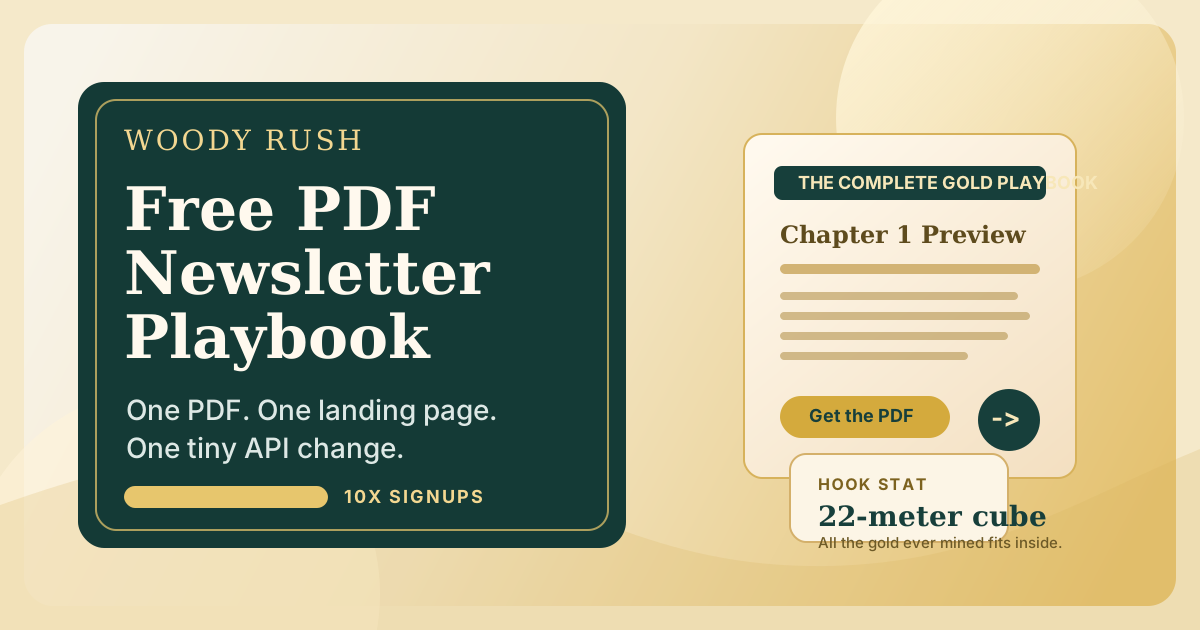
I Used a Free PDF to 10x My Newsletter Signups — Here’s the Exact Playbook
Most indie builders treat newsletters like an afterthought. Slap an email input in the footer, hope for the best. I did that for months with StackFi.io — a hard-asset intelligence site covering gold, silver, and tokenized assets. Signups trickled in. Maybe 2-3 a week.
Then I built a lead magnet PDF in a single afternoon, added an email gate, and the math completely changed. Here’s exactly what I did, why it works, and how you can steal this for your own project.
The Problem: Nobody Subscribes to “a Newsletter”
Here’s the uncomfortable truth — your newsletter isn’t special. Not to a stranger. Everyone has a newsletter now. “Subscribe for updates” is the most ignored sentence on the internet.
People don’t subscribe to newsletters. They subscribe to get something they want. The newsletter is just the vehicle. Your job is to figure out what they want badly enough to hand over their email.
For StackFi, the answer was obvious: my readers were already consuming 2,000-word articles about gold markets, tokenized assets, and macro analysis. They clearly wanted depth. So I packaged the depth into a single, comprehensive PDF — 10 chapters, ~8,000 words — and put an email gate in front of it.
What I Actually Built
The whole system has four pieces:
1. The PDF itself
I wrote a 10-chapter guide called “The Complete Gold Playbook” — covering everything from why gold is scarce (the entire global supply fits in a 22-meter cube) to how to buy tokenized gold on-chain. It’s not a teaser. It’s genuinely useful, self-contained content.
Key decision: the PDF has to be good enough that people would share it. If someone downloads it and feels tricked, you’ve burned the relationship before it started. I wrote it like a real publication, not a marketing brochure.
I used md-to-pdf (an npm package) to convert markdown to a styled PDF with custom CSS — gold accents, clean typography, page numbers, headers. Total file: ~600KB. No design tool needed.
npx md-to-pdf --stylesheet playbook.css content.md2. The Landing Page
A dedicated page at /guide/gold-playbook/ with:
- A hook stat in the hero (“every ounce of gold ever mined fits in a 22-meter cube”)
- A preview of Chapter 1 — four paragraphs visible, then a gradient fade-out. This is the critical UX. Let them taste it. Don’t describe what’s inside — show them.
- A table of contents (10 chapters listed)
- A sticky email capture form on the right side (desktop) or below the preview (mobile)
- FAQ section at the bottom addressing objections (“Is this actually free?”, “Do you earn commission?”)
No navbar, no distractions. This is a conversion page, not a content page. The only action available is: enter email, get the PDF.
3. The Thank-You Page
After submitting their email, users land on /guide/gold-playbook/thank-you/ which:
- Shows the PDF download link immediately (don’t make them check email first — that’s friction)
- Links to two related articles (keeps them on-site)
- Is
noIndexso Google doesn’t crawl it
4. The API Extension
My existing subscribe endpoint (/api/subscribe) already saved emails to Cloudflare KV. I added one field: source. Now every signup includes whether they came from "website" (generic footer form) or "gold-playbook" (the lead magnet). This takes five minutes and gives you segmentation forever.
{ "email": "[email protected]", "source": "gold-playbook" }Where I Put the Entry Point
I added a full-width CTA on the homepage — between “Latest Thoughts” and “Tools.” It’s styled like a book cover with a gold accent, title, and a “Get the playbook →” button.
It’s not a popup. It’s not a banner. It’s a section that belongs on the page. People scroll past it naturally and either click or don’t. Low pressure, high visibility.
The landing page URL is also the ads target:
https://stackfi.io/guide/gold-playbook/?utm_source=x&utm_medium=ads&utm_campaign=gold-playbook
UTM params pass through to the thank-you page so I can see which ad creatives convert.
Why This Works Better Than a Footer Form
Three reasons:
1. Value exchange is explicit. “Give me your email, get an 8,000-word playbook” is a clear deal. “Subscribe to our newsletter” is a vague ask with no immediate payoff.
2. The preview creates desire. Showing Chapter 1 and fading it out is way more effective than describing what’s in the PDF. They’re already reading — they just need the rest.
3. The PDF lives forever. Unlike a blog post that gets buried, a good lead magnet keeps working. Every new article I write can link to it. Every ad can point to it. It’s a permanent conversion asset, not a one-time campaign.
The Technical Stack (for Builders)
Everything runs on what I already had:
| Piece | Tool |
|---|---|
| Site | Astro (SSG) on Cloudflare Pages |
| Email storage | Cloudflare KV |
| Welcome email | Resend API |
| PDF generation | md-to-pdf (npm, one-time CLI run) |
| Landing page | Astro page component, no framework |
| Analytics | UTM params + KV source field |
Total cost: $0 (I was already paying for Cloudflare and Resend). Build time: one afternoon.
What I’d Do Differently
Write the PDF first, then extract the preview. I wrote the landing page copy separately from the PDF content and had to reconcile them. If I did it again, I’d write all 10 chapters first, then pull Chapter 1’s opening paragraphs verbatim for the preview.
A/B test the hook stat. “22-meter cube” is compelling, but I haven’t tested alternatives. The hero stat is the single highest-leverage element on the page.
Add a second lead magnet for silver. Different audience segment, same playbook. Literally duplicate the page, swap the content, change the source tag.
The Takeaway
If you’re running a content site and your newsletter growth is flat, you probably don’t have a newsletter problem. You have a value proposition problem. Nobody owes you their email address.
Build something worth trading for. Package your best thinking into a single artifact. Gate it with an email form. Put it somewhere people will see it.
The whole thing took me an afternoon. The signup rate changed the same day.
I’m Woody, building StackFi.io — hard-asset market intelligence for gold, silver, and tokenized assets. Follow the build on X @stackfiio.

