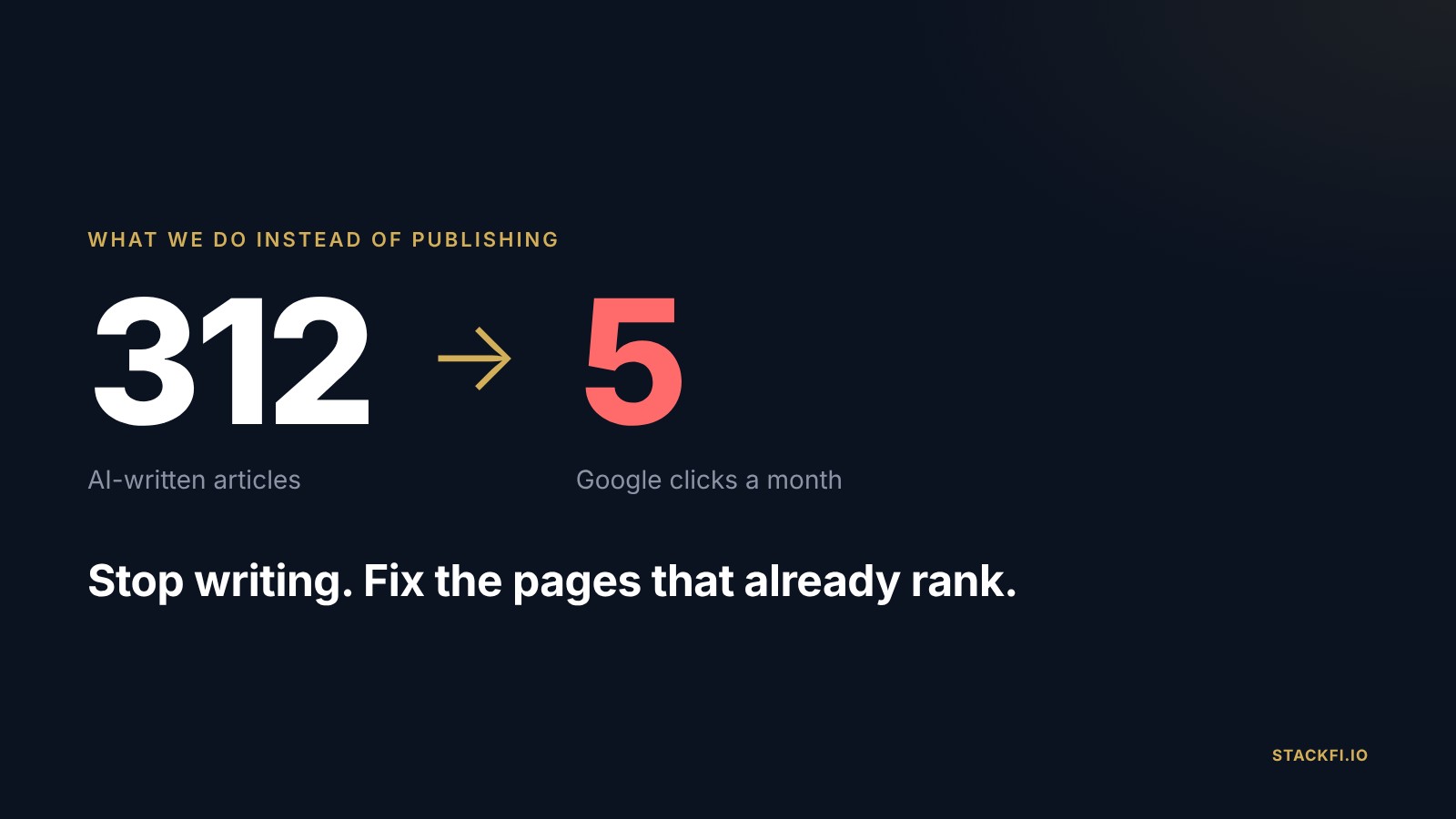
We let AI write 312 articles. Google sent us about 5 clicks a month.
Then we stopped publishing new posts. We only edited pages that already had impressions. Bing impressions over 28 days went from 3,606 to 5,068.
This is the workflow we run now on StackFi: search data, Claude, and 4 prompts you can copy.
One rule runs through all of it: AI finds the gaps. You fill them.
1. First: which search engine is actually sending traffic?
Most tutorials only talk about Google Search Console.
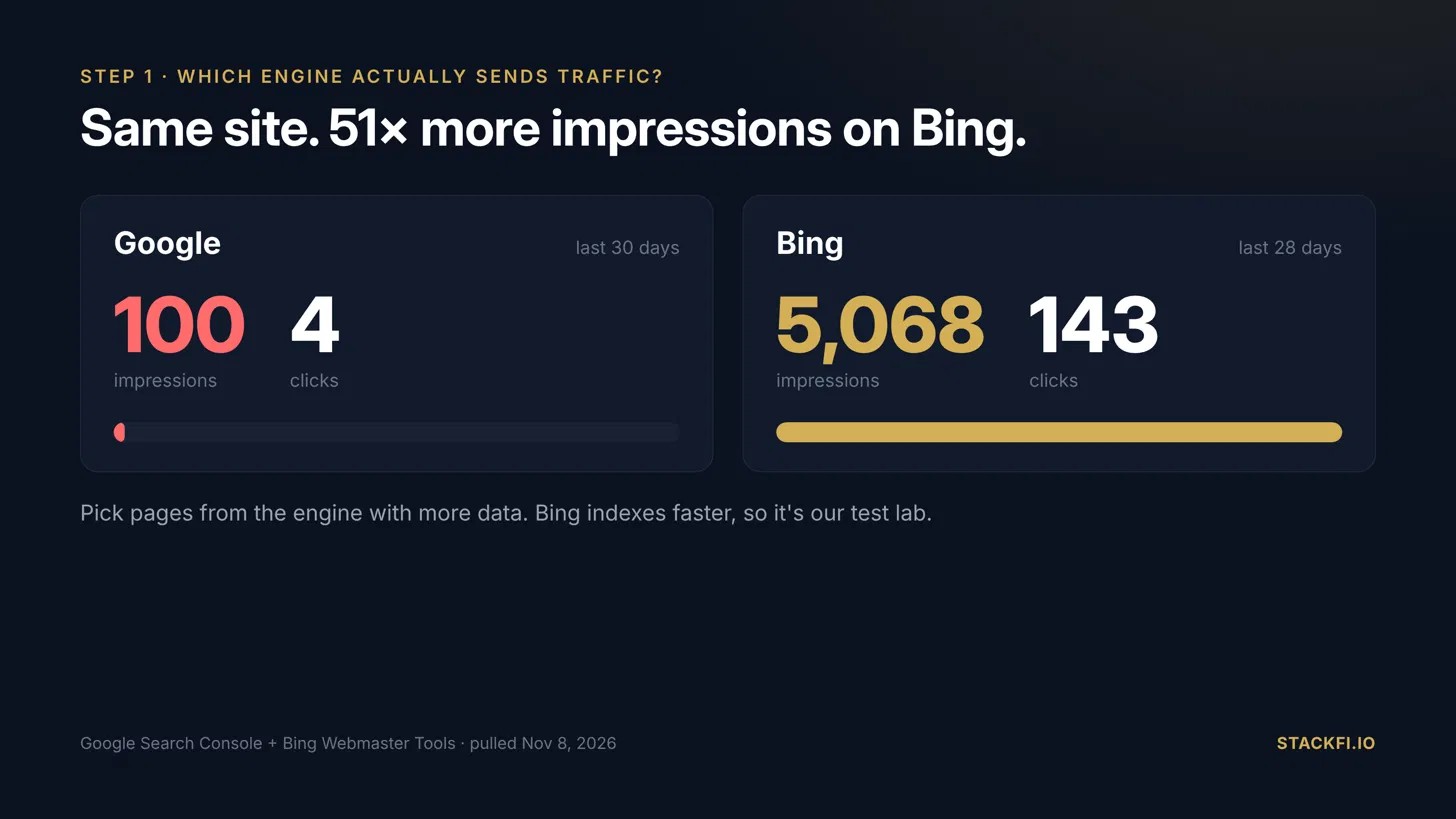
Our last 30 days on Google: 100 impressions, 4 clicks. Our last 28 days on Bing: 5,068 impressions, 143 clicks.
- Open both dashboards.
- Pick pages from the engine with more data.
- Bing indexes faster, so we use it as the test lab.
2. Only work on pages the engine already trusts
Bing Webmaster → Search Performance → Pages (in GSC: Performance → Pages).
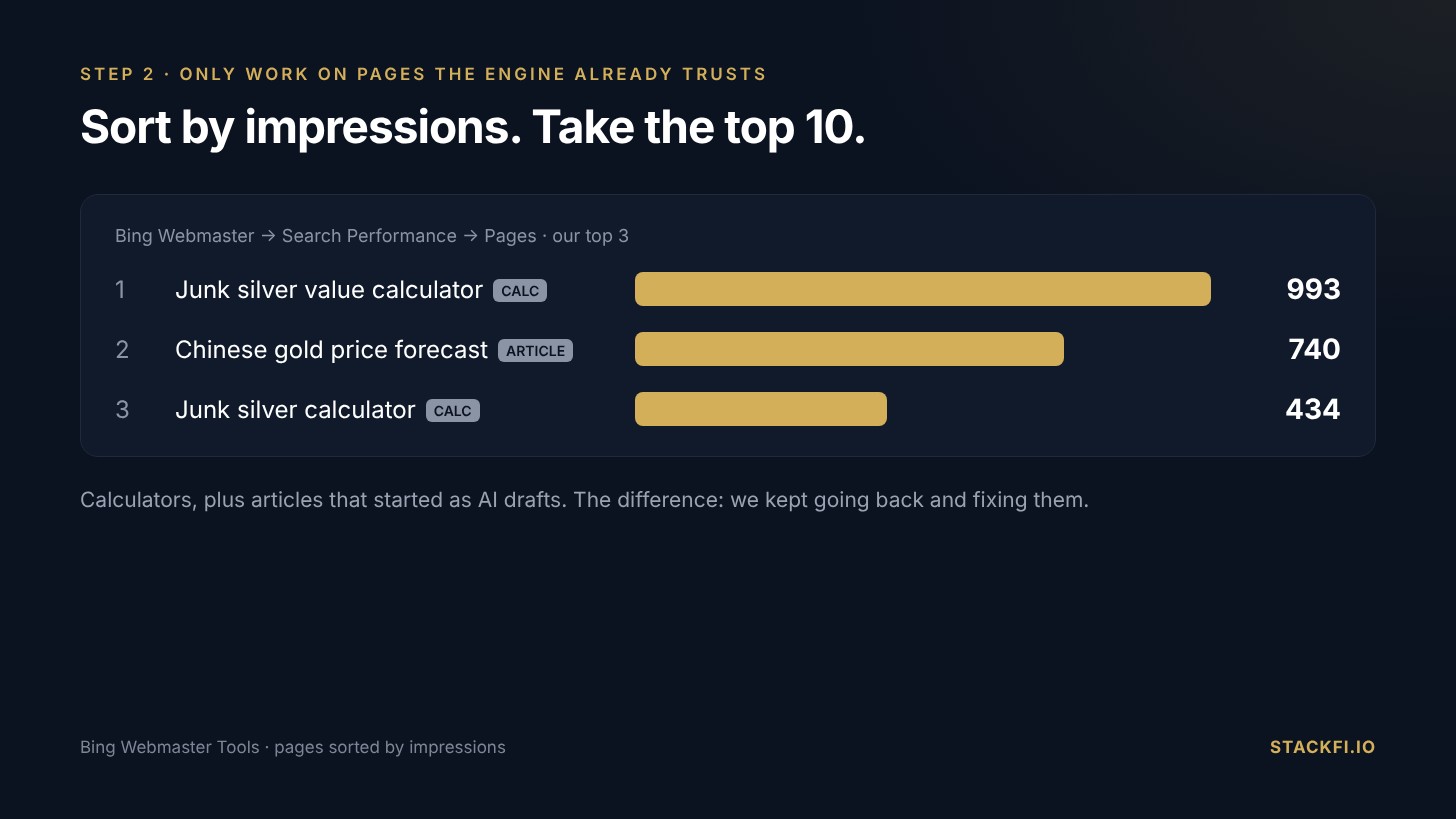
Sort by impressions. Take the top 10.
Our top 3:
- Junk silver value calculator: 993 impressions
- Chinese gold price forecast: 740
- Junk silver calculator: 434
Calculators, plus articles that started as AI drafts. The difference: we kept going back and fixing them.
3. How we feed Claude the data
Three options:
- Do it once: export a CSV and upload it. Fastest.
- Try it: connect an MCP connector so Claude pulls live data.
- Do it every week: an API job dumps data into a repo daily, and Claude reads the files.
We use option 3. GSC, Bing and GA4 land as JSON every day.
Window: 28–90 days. Never 7 days. Too noisy.
4. Hunt two kinds of opportunities
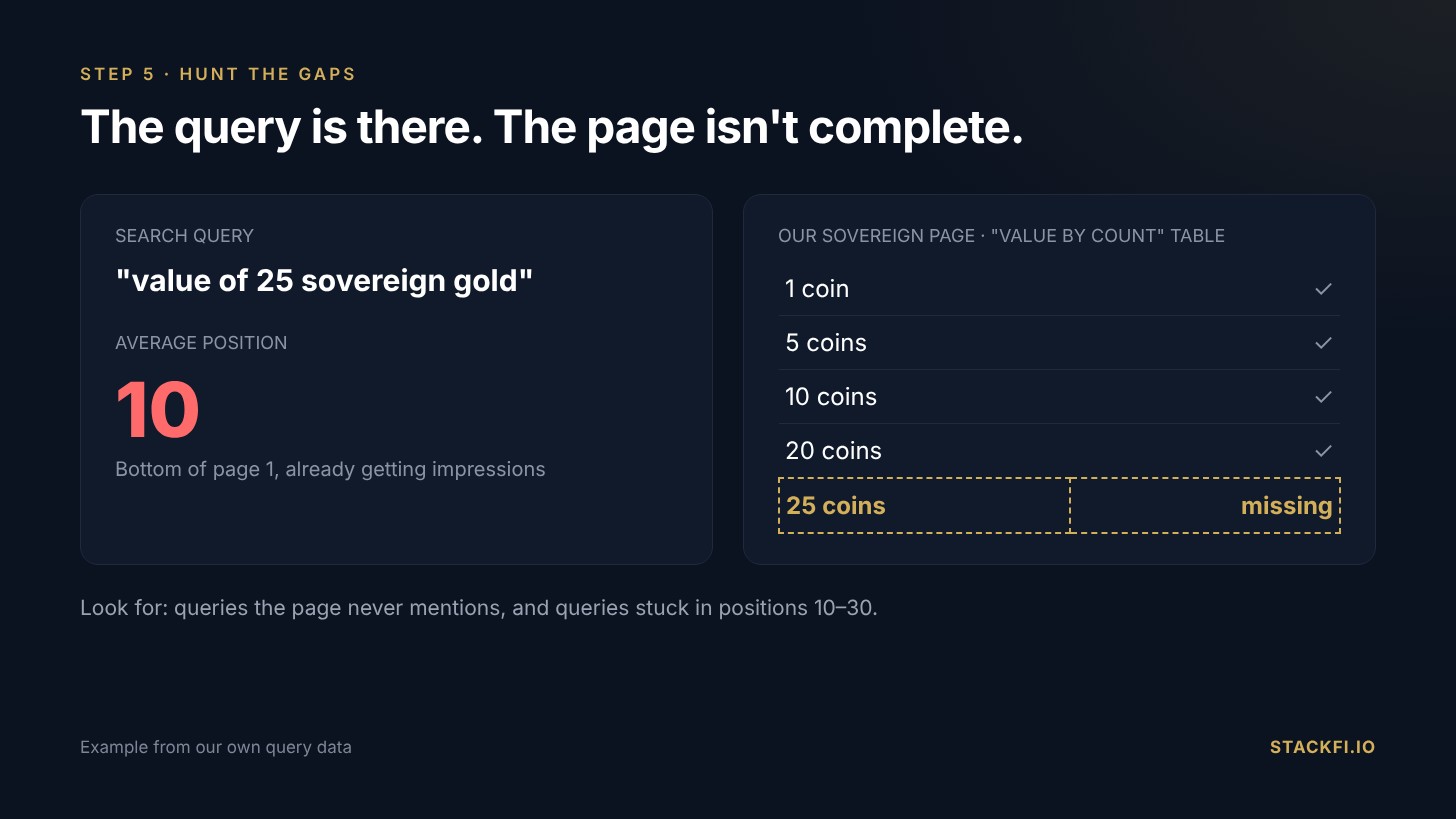
- Queries with impressions that the page never mentions.
- Queries stuck in positions 10–30 (page 2–3).
Example: “value of 25 sovereign gold” sits at position 10. Our sovereign page has a “value by count” table: 1, 5, 10, 20 coins. No 25.
The engine already thinks you’re relevant. The page just isn’t complete.
5. Prompt 1: diagnose one page
This is my page [URL] and its search queries for the last 3 months: [attach file]

Page body: [paste]

1. List queries with impressions that the body does not answer or mention
2. List queries ranking in positions 10–30
3. For each one, say exactly where it belongs: new H2, new paragraph, FAQ, or a tweak to an existing sentence
4. Rewrite only the parts that need to change. Do not rewrite the whole page

Stop after this page and wait for my confirmation.
6. Edit the old page, or open a new one?
- The query already sends impressions to a page, and the reader wants the same thing → edit the old page.
- Answering it needs a different topic for a different reader → open a new page.
- No page has impressions for it → don’t open one yet. Maybe nobody searches it.
Our rules:
- Change one thing per week.
- Don’t touch a page edited in the last 60 days.
- Don’t touch pages already in the top 3.
7. Prompt 2: intro + title
Page: [paste]
Main keyword: [keyword]

1. Do the first 2 paragraphs answer the main question? If not, rewrite the intro
2. Is the main keyword in the title, meta description, and first paragraph?
3. Give me 3 titles under 60 characters and 3 meta descriptions under 155 characters

Keep my tone. No fluff. No filler.
Readers decide in seconds whether you have the answer. So does the search engine.
8. Before you ship: check what AI deleted
We learned this the hard way:
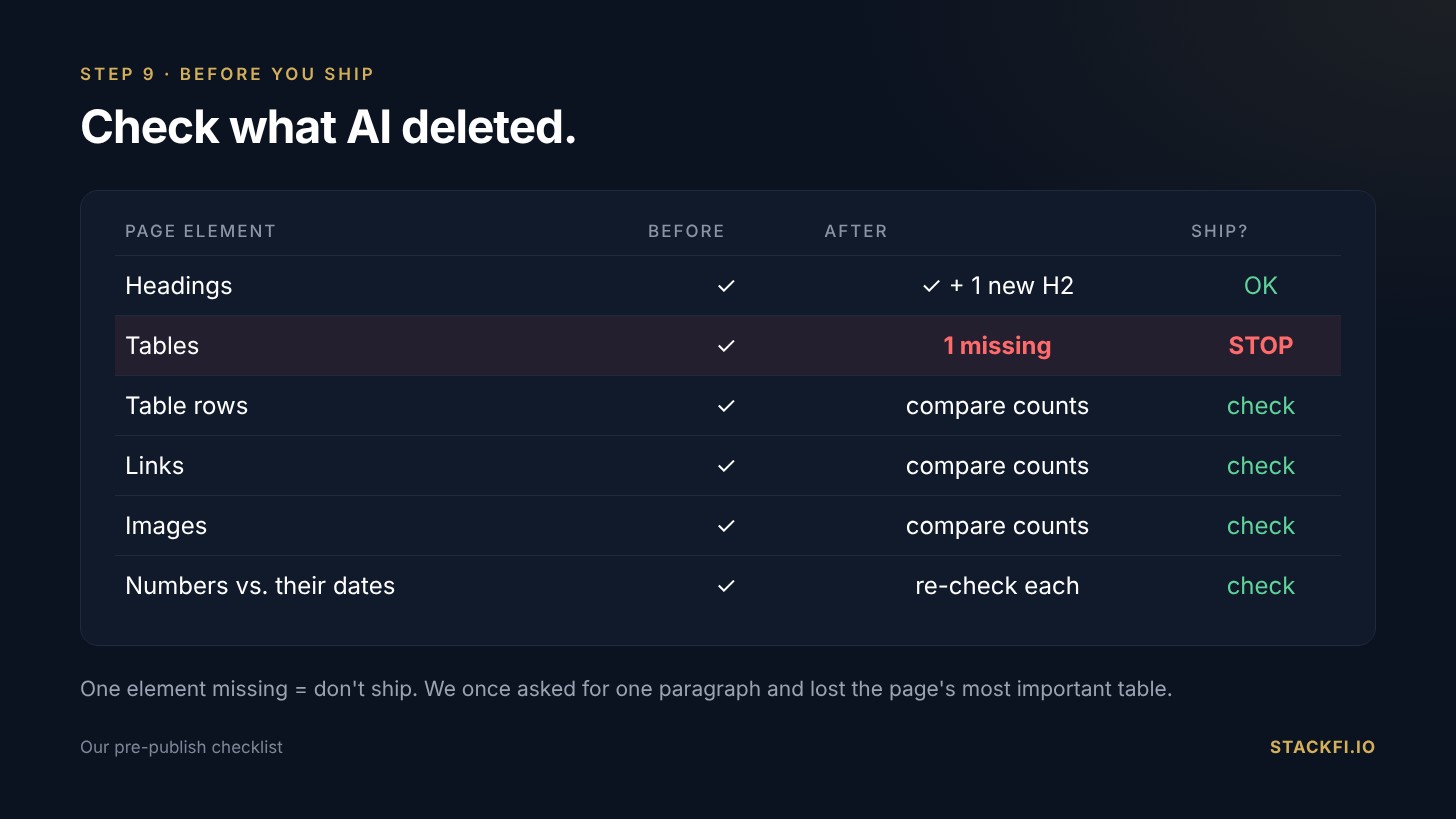
- We asked AI to add one paragraph. It quietly removed the most important table on the page.
- It put a price change calculated on 10/11 next to a 10/20 price.
Our rules now:
- Diff page elements before vs. after: tables, row counts, links, images, headings. One item missing = don’t ship.
- Check every number against the date and price next to it.
9. Prompt 3: make it yours
Page: [paste]

1. Where would a screenshot, table, or diagram help more than text? Say exactly what to show and why
2. What do the top 5 results for "[keyword]" all say the same way?
3. Give me 3 angles I can write from my own experience
Then you fill in:
- real dashboard screenshots;
- your own data (ours: daily prices, premiums, history tables);
- your judgment, written by you. Zero AI.
AI can’t screenshot your backend. That’s the edge.
10. Prompt 4: internal links
Here is my page list. Each line is URL + main keyword: [paste]

Suggest internal links between them.
For each link give: source page, target page, the exact sentence it fits in, and the anchor text.
Only links a reader would actually click.
Max 3–5 per page.
Our bar: a new page isn’t “live” until at least 5 related pages link to it in body copy.
11. Do you need to request indexing by hand?
- Bing: wire up IndexNow. Updates submit themselves.
- Google: use URL Inspection only on the key pages you changed. Don’t click every URL.
- Don’t use the Google Indexing API for normal articles. It’s for job posts and livestream pages. We stopped using it.
Then wait. Bing: 2–4 weeks. Google: 4–8 weeks.
Pull the same query table again and compare.
12. Backlinks last
These 10 pages are your link targets. They already rank. A few links can move them from page 2 to page 1.
What we do:
- Find Reddit and forum threads where people ask the exact question.
- Answer the question first. Add the calculator link only when it’s relevant.
2–5 a month is enough.
13. What you should see in 1–3 months
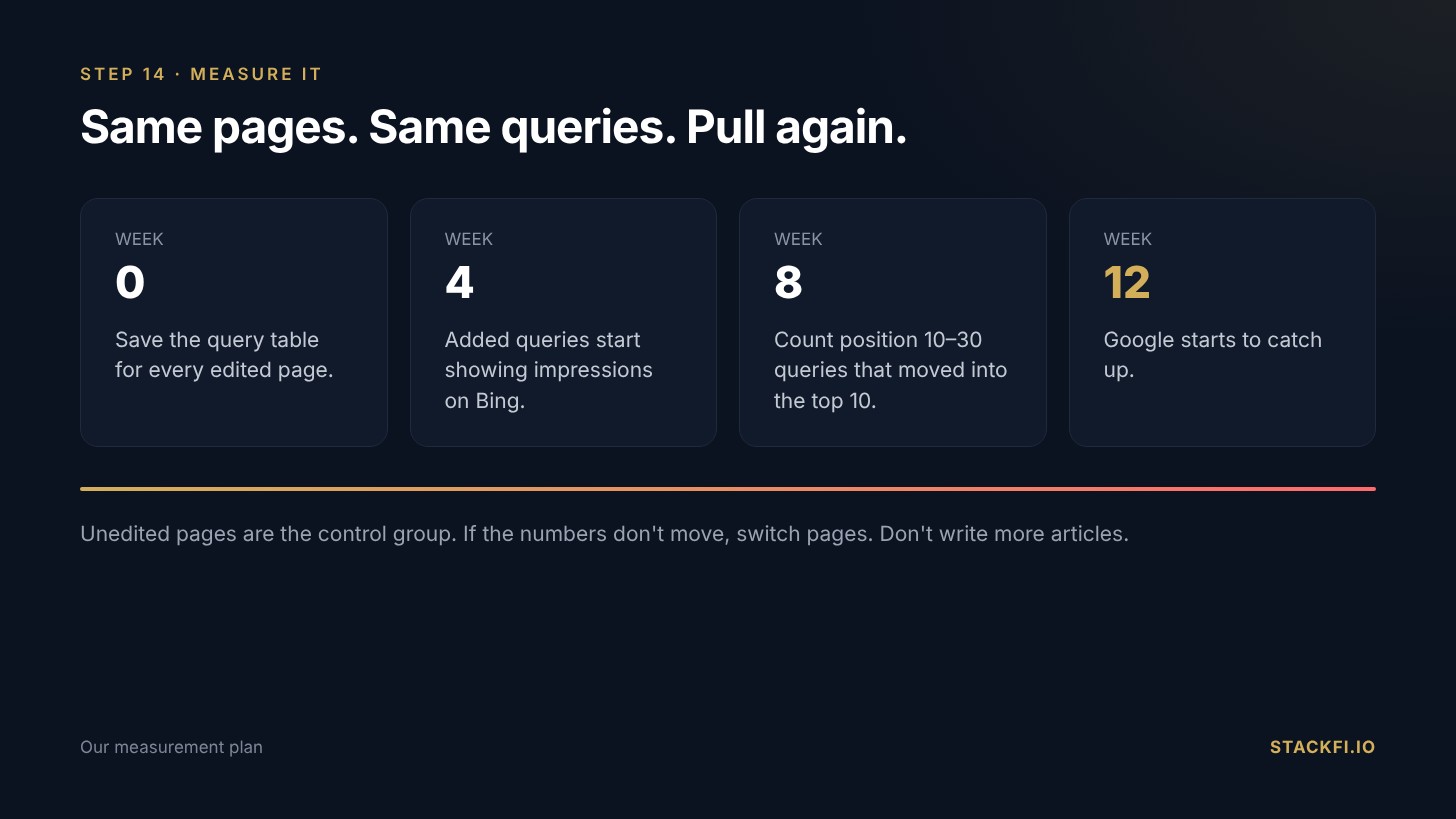
- Weeks 2–4: the queries you added start showing impressions on Bing.
- Weeks 4–8: count how many position 10–30 queries moved into the top 10.
- Weeks 8–12: Google starts to catch up.
How we verify:
- Week 0: save the query table.
- Weeks 4, 8, 12: pull the same pages and the same queries.
- Unedited pages are the control group.
If the numbers don’t move, switch pages. Don’t write more articles.
Recap
- See which search engine actually sends you traffic.
- Take the top 10 pages by impressions.
- Feed Claude: CSV, MCP, or API.
- Hunt missing queries + positions 10–30.
- Prefer editing old pages; don’t open new ones for queries with zero impressions.
- Answer the main question in the first 2 paragraphs; put the keyword in the title, meta and first paragraph.
- Diff page elements before shipping; check every number.
- Screenshots, your data, your take: write them yourself.
- Internal links: 3–5 per page.
- Bing via IndexNow; Google only on key URLs.
- Wait 4–8 weeks, then pull the same table.
- Backlinks last: 2–5 a month.
Fixing pages that already rank beats writing new ones. We paid 312 articles to learn that.